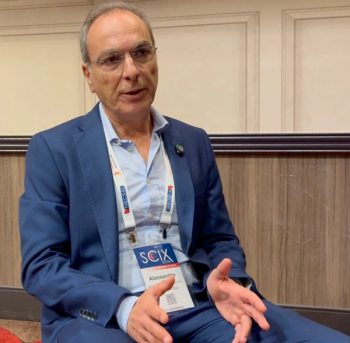
At SciX, Kevin Wilkinson of the Universite de Montreal explains how faster data acquisition and new software have cut analysis time and how a particle’s chemical composition can link arsenic-bearing emissions back to a copper refinery’s processes.
ICP offers greater speed, precision and sensitivity compared to atomic absorption techniques of mass spectrometry. But ICP is also subject to higher levels of interference. Spectroscopy spoke with Jerry Delude, President of Glass Expansion, about recent advances in sample introduction systems that enable users to meet ever-tighter analytical specifications.
ICP offers greater speed, precision and sensitivity compared to atomic absorption techniques of mass spectrometry. But ICP is also subject to higher levels of interference. Spectroscopy spoke with Jerry Delude, President of Glass Expansion, about recent advances in sample introduction systems that enable users to meet ever-tighter analytical specifications.