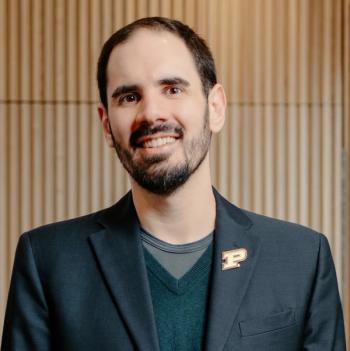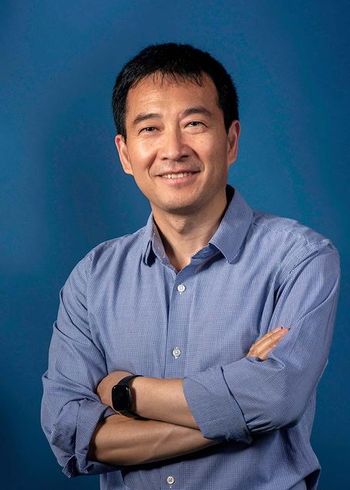
An upcoming interview with Ji-Xin Cheng, a Theodore Moustakas Distinguished Professor in Photonics and Optoelectronics at Boston University, will highlight his ongoing work in coherent Raman scattering microscopy.
On September 20, 2017, Hurricane Maria devastated Puerto Rico, leaving the inhabitants without clean water, food, utilities and transportation. As you read this, the infrastructure is slowly being restored. The news you hear, however, doesn’t indicate the outsized impact on scientists and their families. The Society for Applied Spectroscopy and Coblentz Society are trying to help.
On September 20, 2017, Hurricane Maria devastated Puerto Rico, leaving the inhabitants without clean water, food, utilities and transportation. As you read this, the infrastructure is slowly being restored. The news you hear, however, doesn’t indicate the outsized impact on scientists and their families. The Society for Applied Spectroscopy and Coblentz Society are trying to help.
Take a moment to look at your workplace as a scientist and researcher. Your work is specialized and you have spent years training people, acquiring instrumentation, and building laboratory infrastructure. Then imagine yourself picking up and leaving with just a few days’ notice. Now, consider that your equipment and labs are flooded and the power was out for many weeks after the storm. You have modern analytical instruments that have been designed for constant temperature and humidity environments. They have been exposed to extended periods of high humidity (>90%) for weeks on end. Mold is growing on surfaces. Puddles of moisture are collecting within the instruments. Other instruments were destroyed by brownouts. Even so, leaving is still not an option, because of all the investment you have made to develop a lab, team, and funding situation that is suitable for the work you can uniquely do.
This is the situation experienced by the spectroscopy community at the University of Puerto Rico at Mayaguez. Sam Hernandez-Rivera, a chemistry professor there, recently
Of course, the impact is broader and deeper than just one lab. The work of over 50 graduate students has been significantly disrupted. Research projects are now delayed or cancelled because researchers have no access to workspaces and experimental equipment. Imagine that you are a graduate student who in September had three key experiments to complete to write a paper. After this devastation, when or how will you get those three key experiments completed? Maybe never. Undergraduates are affected as well. The teaching and experience they receive is dependent on the professors, the graduate students, and their own experiences at the research facilities.
Thirty-eight professors now are faced with a halt to their life’s work. Labs are in ruins. Reagents that need refrigeration are useless. These are productive scientists. Professor Hernandez alone has 190 publications and has mentored over 60 students.
The scientific endeavor in Puerto Rico as a whole will suffer. The chemistry department educates an average of 100 chemists per year. This year, those chemists are not going to be trained. That will hurt scientific employers on the island.
It is time for our community to act to support our colleagues, and we need your help.
Science is a community effort, so we must now come together to solve this problem. That’s why the spectroscopy community, led by the Coblentz Society and the Society for Applied Spectroscopy, is rallying a volunteer effort to support our colleagues. This support can be provided in various forms:
Without this support, students will return to their communities with unfinished educations and their future prospects will be stunted. We are not seeking to provide disaster relief; we are enabling self-help.
Consider donating now.