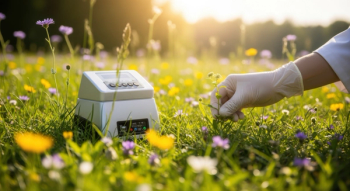

In the second part of our interview with Brandon Boor of Purdue University, he discusses how his team controls experimental variables during cleaning experiments in order to obtain interpretable data.
One of the fastest growing new areas of demand for Raman spectroscopy is in the security market. Technological improvements have helped to unlock the large potential of the technique for security applications. There has been a rash of acquisitions in the market that have completely reshaped the competitive landscape over the last few years, which is typical of such dynamic markets.
One of the fastest growing new areas of demand for Raman spectroscopy is in the security market. Technological improvements have helped to unlock the large potential of the technique for security applications. There has been a rash of acquisitions in the market that have completely reshaped the competitive landscape over the last few years, which is typical of such dynamic markets.
Raman spectroscopy is very well suited to the identification of explosives and other compounds for security applications. It provides a nondestructive analytical technique that provides highly specific data, which makes it an extremely good technique for identification of unknowns. Furthermore, it is more sensitive to nonpolar compounds than polar compounds, and therefore water and moisture do not interfere as they do with infrared and near-infrared techniques. However, such strengths of the technique were useless without many of the technological advancements made in lasers and optics over the past decade.
Raman spectroscopy for security applications: vendor share in 2010.
There has been quite a bit of merger and acquisition activity in the market space over the past three years. Thermo Scientific has become the strong leader in Raman spectroscopy for security applications thanks to its acquisition of fast growing Ahura Scientific. The Morpho division of the French-based SAFRAN Group, which was formerly a part of GE, has been in the market for a number of years. ICx Technologies, which was recently acquired by FLIR Systems, entered the handheld Raman market in 2009 and has quickly become a significant player. Intevac was slightly ahead of its larger competitors with its acquisition of DeltaNu in 2007. In 2010 the market for Raman in security applications grew to well over $60 million in 2010, and it is expected to see very strong double-digit annual growth for the foreseeable future.
The foregoing data were extracted from SDi's market analysis and perspectives report entitled The Global Assessment Report, 11th Edition: The Laboratory Life Science and Analytical Instrument Industry, October 2010. For more information, contact Stuart Press, Vice President, Strategic Directions International, Inc., 6242 Westchester Parkway, Suite 100, Los Angeles, CA 90045, (310) 641-4982, fax: (310) 641-8851,
over 15 years ago
Productsover 15 years ago
Maxwell's Equations, Part I: Historyover 15 years ago
Is GMP Annex 11 Europe's Answer to 21 CFR 11?over 15 years ago
LIBS in Forensicsover 15 years ago
Keep Your Distanceover 15 years ago
Vol 26 No 4 Spectroscopy April 2011 Regular Issue PDF