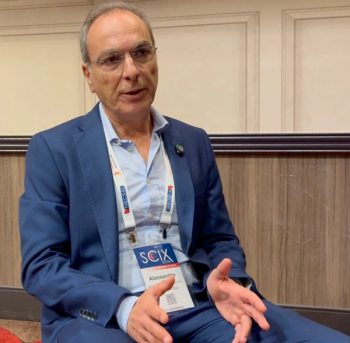
In a SciX interview, Marc Porter covered a lot of ground, from a student-driven pivot into immunoassays to a baseball analogy for Stokes and anti-Stokes scattering, and shares the open questions he is still chasing.
Spectroscopy previews the upcoming IFPAC Annual Meeting, to be held January 25–28, 2009, in Baltimore, Maryland.
Spectroscopy previews the upcoming IFPAC Annual Meeting, to be held January 25–28, 2009, in Baltimore, Maryland.
The 23rd International Forum for Process Analytical Technology (IFPAC-09) will be held at the Baltimore Marriott Waterfront Hotel, located within Baltimore's Inner Harbor, from January 25 through January 28, 2009. IFPAC is the leading conference in process analysis and technology, and this will be an exciting forum in which to learn about recent developments in the field of process analytical chemistry, technology, and control applications in many different industries.
In addition to the conference events, attendees can enjoy various shops and harbor restaurants, the Baltimore National Aquarium, the Maryland Science Center, The Peabody Conservatory, and more.
On Sunday afternoon, January 25, Lawrence Yu, Steven Kozlowski, and Christine Moore, of the FDA, will present a special workshop entitled Quality by Design in Pharmaceutical Development and Manufacturing: An FDA Update. This in-depth look at the FDA's viewpoint of their Quality Initiative will be presented from the perspective of their three review offices: biotech products, generic drugs, and new drugs. The purpose of this workshop is to discuss implementation progress of Quality by Design (QbD) and process analytical technology within the pharmaceutical and biopharmaceutical industries with the goal of supporting overall operational excellence. The program will end with an interactive roundtable discussion that encourages audience participation and networking among attendees.
The plenary session, Operational Excellence Through Process Understanding and Control ... Facing Today's Challenges, will be chaired by Stephen Jacobs, Duncan Low, and Christine M.V. Moore on Monday morning, January 26.
Daily lectures, workshops, and short courses focusing on the latest developments in process analytical technology will be conducted by leading experts in their respective fields. Topics include separation techniques, Raman spectroscopy, chemical imaging, process control and quality, electrochemical techniques, chemometrics, pharmaceutical design space, PAT for biologics manufacturing, handheld (portable) instrumentation, standards in process analytical chemistry, and future trends.
The three-day exhibit hall will be open from January 26–28, 2009, at the conference. The exhibit floor is considered an integral part of the annual conference, and showcases the new products and services most desired by this specialized audience.
All-inclusive registration includes three days lodging and meals. For more information and to register online, visit the IFPAC web page at
IFPAC Committee
253 Commerce Drive, Suite 103
P.O. Box 7100 Grayslake, IL 60030
Phone: (847) 543-6800;
Fax: (847) 548-1811
Email:
almost 18 years ago
Active Volcanoes in Space?almost 18 years ago
How Will Distributed Sensing Inspire Changes in Optical-Sensing R&D?almost 18 years ago
Productsalmost 18 years ago
Market Profile: LC-ICP-MSalmost 18 years ago
The Seven Base Units, Part Ialmost 18 years ago
Mid-Infrared Gas Sensing Using a Photonic Bandgap Fiber as a Gas Cell