




Plastics Polymers and Rubber
Latest News
Advertisement
Latest Videos
Advertisement
More News

We study the spectra of organic nitrogen polymers with a particular focus on polyamides.

Studying the crystallinity of biodegradable polymers can be done without the complexity of larger instruments. Here’s how.
Epoxies are perhaps the most economically important functional group of polymers. We explain how to interpret their spectra.
Many rubbery polymers contain C=C bonds, which means they are alkenes. Thus, we can identify natural and synthetic rubbers by examining the spectra of cis-, trans-, and tri-substituted alkenes.
Here, we finish a discussion of the spectrum of polyethylene (PE) and explore how different PE syntheses produce materials with different physical and spectroscopic properties.

Naoto Nagai, of the Industrial Research Institute of Niigata Prefecture in Japan, has been studying the potential of IR spectroscopy for investigating higher-order structures of polymers. He and his colleagues recently looked at the IR spectra of polyoxymethylene (POM) mold plates and the cause of occasional resin cracks.
Special Issues
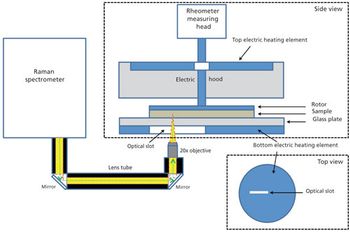
The in situ combination of rheometry and Raman spectroscopy allows for real-time, synchronized measurement of both physical and chemical material properties.
Special Issues
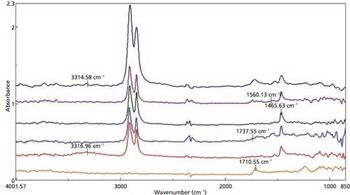
Polymer laminates typically make complex samples for infrared analysis, comprising multiple layers with defined thicknesses, in some cases less than 10 µm. When measuring extremely narrow laminate layers, the use of attenuated total reflectance (ATR) may provide improved spectra of the laminate cross-section, because ATR microscope objectives offer a greater spatial resolution than transmission due to additional magnification. This paper details the preparation of polymer laminate sample cross-sections and the collection of transmission and ATR spectra of various layers. Further analysis of the laminate spectra will also be explored utilizing a multivariate curve resolution (MCR) algorithm. An example laminate sample is examined utilizing all the tools available on a standard FT-IR microscope.
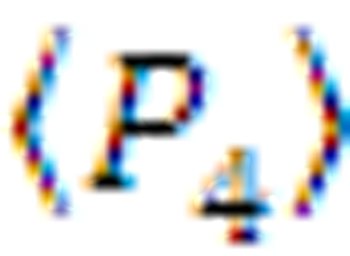
Christian Pellerin, a professor in the Department of Chemistry at the University of Montreal in Canada, is using Raman spectroscopy and the most probable distribution method to quantify the orientation of polymers and electrospun fibers. Spectroscopy recently spoke with him about this work.

Special Issues
The mechanical properties of polymer films such as tensile strength and resistance to tearing depend strongly on the orientation of the polymer chains. Fourier transform infrared (FT-IR) spectroscopy can be used to measure the degree of orientation both within the plane of the film and normal to it.
Spectroscopy
A new method allows samples to be measured "as-is" with direct contact with the ATR crystal.
Special Issues
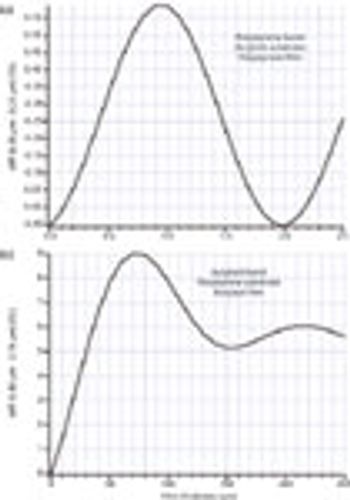
Infrared reflection spectroscopy is a tool that can be used to study coated plastics, but the spectra can show unexpected features. In this report, we calculate the specular reflectance for a flat surface of two different polymers as well as how their spectra change when the other polymer is added as a film with a thickness of up to 2.5 ?m. One of the unusual phenomena we observe is that "derivative"-shaped substrate bands invert in sign as the other polymer is added as a coating. We also show how the reflection of the surface changes and becomes polarized as the angle of incidence increases.
Special Issues
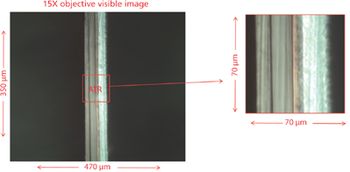
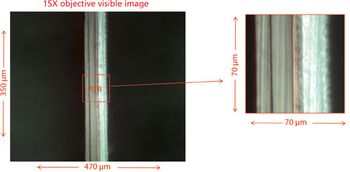
The micro attenuated total reflectance (ATR) chemical imaging of polymers, in particular polymer laminates, typically requires significant pressure to ensure good sample-to-ATR crystal contact. For thin cross-sectioned materials, ensuring structural rigidity against this pressure requires significant sample preparation, such as resin embedding, cutting, and polishing.

Spectroscopy
The interpretation of Raman spectra is discussed for a series of functionalized celluloses.
Special Issues
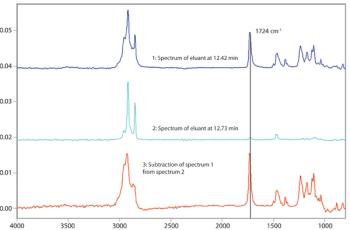
Liquid chromatography–mid infrared spectroscopy (LC-IR) is a powerful tool for copolymer analysis. This article describes an automated, self-regulating solvent-removal interface that produces continuous transmission spectra from the deposited, solvent-free, solid-phase chromatogram.
Special Issues
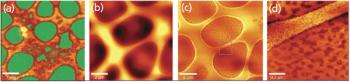
Polymer blends are designed to address the needs of different industries, and in many cases the relationship between structure, morphology, and material properties is indispensable for optimization of material design.

Spectroscopy
The study of the photophysical and optoelectronic properties of a functioning conducting polymer device is complicated and is hampered by the complex nanostructure and morphology of the conducting polymer materials in these devices. Here we discuss an approach to investigate this issue in terms of bulk-heterojunction organic photovoltaic devices.
Advertisement
Advertisement
Trending on Spectroscopy Online
1
Vanishing Spectrometers: How Near-Infrared Instrumentation Got Small, Smart, and Everywhere
2
Sizing Up the Nanoscale: Measuring Nanocluster Aerosol in Indoor Air
3
SciX 2026 Preview: The Charles Mann Award for Applied Raman Spectroscopy
4
From Better Spectra to Better Decisions: Five Trends Highlighted at ICORS 2026
5