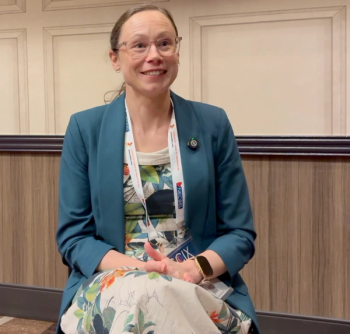
At SciX, Jay Kitt describes the experiment he ran on his own that launched his cytochrome c research, and explains why putting a number on peptide–lipid interactions matters.
In this edition of “Inside the Laboratory,” Maryam Shakiba and Santiago Marin of the University of Colorado Boulder discuss the findings of their latest paper, which provides a predictive framework for understanding and forecasting long-term thermo-oxidative degradation in polyimides.
A recent study examined how prolonged exposure to high-temperature oxidative environments can affect the structure and mechanical performance of semi-crystalline polyimide films. Published in the journal Polymer Degradation and Stability, the researchers used X-ray diffraction (XRD), Raman spectroscopy, and tensile testing to reveal that aging increases crystallinity, alters molecular functional groups, and causes significant stiffening and embrittlement in this polymer film (1).
Maryam Shakiba, lead author of this paper, is an Assistant Professor in the Aerospace Mechanics Research Center (AMREC) at the University of Colorado Boulder (2). Along with her graduate students, Marwa Yacouti and Santiago Marin, she developed a constitutive viscoelastic–viscoplastic model that accurately predicts the stress–strain behavior of thermo-oxidatively aged films without requiring mechanical recalibration at each aging stage (1).
In this edition of “Inside the Laboratory,” Shakiba and Santiago Marin, a graduate student who works under Shakiba, discuss the findings of their latest paper, which provides a predictive framework for understanding and forecasting long-term thermo-oxidative degradation in polyimides.
What motivated your team to investigate thermo-oxidative aging in semi-crystalline polyimide films, and why was Kapton HN chosen as the model material?
Thermo-oxidative degradation is a very relevant aging mechanism for semi-crystalline polymers because they are widely used in engineering applications where they are exposed to elevated temperatures for long periods. We focused specifically on polyimides because they are high-temperature semi-crystalline polymers used in demanding environments. For example, they are used in aerospace and aeronautics, flexible electronics, sunshield membranes, and even as matrix materials in composites. They are engineered to resist degradation, which makes it extremely interesting to understand how and when they actually begin to degrade.
We selected Kapton HN as our model system because it is the flagship commercial aromatic polyimide, heavily used across industry and space missions. However, Kapton is notoriously difficult to characterize; its strong chemical resistance and exceptional thermal stability make it challenging to probe experimentally. Historically, this has limited detailed studies and modeling efforts. As polyimides are now being pushed into even more extreme conditions, understanding how these “stable” materials degrade has become both scientifically and technologically essential.
How did the combination of XRD, Raman spectroscopy, and tensile testing complement one another in revealing the microstructural and mechanical evolution of the aged films?
Each technique probes a different scale of the degradation mechanism, and that complementary view is key. With Raman spectroscopy, we can track what is happening at the molecular level, for example, oxygen incorporation, bond transformations, and signatures related to crosslinking or chain scission. With XRD, we can quantify how the polymer chains reorganize physically, whether the amorphous regions reorganize into more ordered crystalline domains during aging. Knowing not only what bonds change, but also how chains pack is essential to understand stiffness changes. Finally, the mechanical tests tell us the macroscopic consequences. The stiffening and loss of ductility we measured in tension were fully consistent with what we observed in Raman and XRD, which was increases in crystallinity and molecular changes consistent with oxidation-induced crosslinking that in turn increases stiffness and causes embrittlement.
Therefore, Raman spectroscopy tells us how the molecules change, XRD tells us how those molecules arrange, and tensile tests confirm how those changes manifest in macroscopic mechanical properties.
Your results indicate an increase in crystallinity and the emergence of specific molecular changes during aging. How do these structural transformations contribute to the observed stiffening and embrittlement?
The increase in crystallinity means the polymer chains become more ordered and densely packed. When the chains organize into crystalline regions, molecular motion becomes restricted, leading to a stiffer material. In parallel, oxidation-induced crosslinking creates additional chemical bonds between polymer chains, which further limit molecular mobility. Both mechanisms, higher crystallinity and increased crosslink density, restrict the polymer’s ability to deform plastically. This combination explains the stiffening and the progressive transition from ductile to brittle behavior that we observed in our tensile experiments.
Can you elaborate on how the degradation indicators derived from XRD and Raman spectroscopy were integrated into your viscoelastic–viscoplastic constitutive model?
The mechanical response of polymers is quite complex. Unlike purely elastic materials, polymer behavior depends on both time and temperature. Polyimides, in particular, not only exhibit time- and temperature-dependent deformation (viscoelasticity) but can also undergo time- and temperature-dependent permanent deformation (viscoplasticity). Our model is based on a viscoelastic–viscoplastic framework that captures how polyimides deform under load. Experimentally, we observed that after thermo-oxidative aging, the material becomes more and more brittle. This means that the viscoplastic part of the deformation (which governs large, irreversible deformations) becomes very limited, even after short aging times.
For this reason, we focused on modifying only the viscoelastic portion of the model, specifically the parameters that control the nonlinear stiffness of the material.
To make these adjustments, we defined two degradation indicators: one from XRD, which reflects how crystallinity evolves during aging, and one from Raman spectroscopy, which captures chemical changes and the evolution of molecular bonds. We normalized both indicators using the unaged material so they could be compared consistently, especially since Raman intensity is not an absolute property. Finally, we incorporated these indicators into the stiffness-related coefficients of the model. In practice, this means that as crystallinity increases or as oxidation leads to more crosslinking, the model automatically predicts a stiffer and less compliant material, exactly as observed in our experiments.
What advantages does your predictive framework offer compared to traditional approaches that require separate mechanical recalibration for each aging condition?
Conducting mechanical tests on polymer samples can be challenging, and there are only a limited number of tests that can practically be performed. Moreover, if we develop a model based solely on tensile tests, we cannot be certain that it will accurately predict behavior under shear or combined loading. In contrast, our model is based on the characterization of the polymer network’s microstructure and how this network evolves under thermo-oxidative conditions. Therefore, it is not dependent on the specific type of mechanical test being conducted. Moreover, we only need to calibrate the unaged material once, and then we can predict its aged mechanical behavior based solely on physico-chemical characterization results, such as XRD and Raman spectroscopy.
Also, imagine designing a component for an aircraft. If we have a small reference sample made from the same material that has already experienced service conditions, we could perform characterization tests like XRD, Raman, or FT-IR on that sample. Using those results, our model can predict how a new part will behave after thermo-oxidative degradation during operation, without the need for additional mechanical testing. This capability makes the framework much more efficient and practical for predicting long-term performance of polymers in high-temperature environments.
Looking ahead, how might this experimental–computational methodology be extended to other high-performance polymers or to predict long-term performance in real-world aerospace or electronics applications?
We are interested in predicting the mechanical response and performance of polymers and polymer matrix composites (both thermoplastic and thermoset) under extreme environmental conditions. Our goal is to develop theoretical and computational frameworks grounded in the physics and chemistry of degradation, with strong predictive capabilities. In addition to thermo-oxidation, the extreme environments we focus on include UV radiation, humidity, atomic oxygen exposure, and ablation, conditions that are particularly critical for spacecraft materials.
The overarching goal is to build predictive models that are firmly grounded in the underlying physics and chemistry of degradation. By using experimentally measurable indicators, we can directly link microscopic transformations to macroscopic mechanical behavior. This approach will ultimately enable reliable, experimentally informed predictions of material performance and lifetime across a wide range of high-performance polymers used in aerospace, electronics, and other demanding environments.