Register Now: Advances in Spectroscopy for Pharma and Biopharmaceutical Analysis Symposium
|Articles|September 1, 2007

Application Notebook

  • Application Notebook-09-01-2007
  • Volume 0
  • Issue 0

Classification of Bacteria Using FT-IR

Thermo Fisher Scientific


Related to this article

Curated 2026 Evergreen Content from Spectroscopy. ©  Chanakarn -chronicles-stock.adobe.com
Spectroscopy's editors gather 143 evergreen articles from 2026, including tutorials, terminology guides, technique reviews, application surveys, peer-reviewed research and the magazine's long-running columns, and organize them by subject so readers can build lasting knowledge one topic at a time.
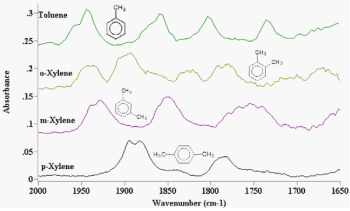
Highly Substituted Benzene Rings—The Rest of the Story II: Spectra
This column, the second installment on highly substituted benzene rings, shows that tri- and tetra-substituted substitution patterns can be distinguished by whether the ring-bending peak is present and by the position of the in-phase aryl C-H wagging peak, which shifts according to how many adjacent hydrogens the ring carries.
Spectral Frontiers: Seeing the Unseeable Microspectroscopy
Microspectroscopy, the marriage of spectroscopic chemical identification with microscopic spatial resolution, has advanced from Perkin-Elmer's first commercial infrared microspectrometer in 1953 to today's nanoscale AFM-IR probes, synchrotron-brightness infrared beamlines, and compact hyperspectral tissue imaging devices being developed for AI-assisted cancer detection.
Tutorial Tuesday: When to Use Infrared Spectroscopy
In this “Tutorial Tuesday” clip, Peter Larkin, who is a Manager of Spectroscopy, Thermal Analysis, and Chromatography at Syensqo, highlights how people use the method or technique that they are comfortable with, even if it’s not the best one to use.