|Articles|April 30, 2013

Pharmaceutical Technology and BioPharm Launch New E-Directory for Analytical Instrumentation and More

Advanstar Communications (New York, New York) has announced the launch of the new Pharmaceutical Technology and BioPharm International Marketplace eDirectory built on the online Credibility Review Business Marketplace platform developed by Dun and Bradstreet Credibility Corp. (Malibu California). Advanstar Communications are the first B2B publishers to embrace the platform.

Advanstar Communications (New York, New York) has announced the launch of the new Pharmaceutical Technology and BioPharm International Marketplace eDirectory built on the online Credibility Review Business Marketplace platform developed by Dun and Bradstreet Credibility Corp. (Malibu, California). Advanstar Communications are the first B2B publishers to embrace the platform.

Advanstar Communications has been a publisher of pharmaceutical life science publications for over 50 years, including the titles LCGC North America, LCGC Europe, LCGC Asia Pacific, and Spectroscopy. This eDirectory is designed to present industry-leading editorial content with detailed product information on one platform.

The Pharmaceutical Technology and BioPharm International marketplace is designed to be an on-line community for buyers and suppliers. It allows the rating of products and services, and also allows the integration of real-time social media feeds. It will concentrate on business information and news from companies in the following categories: Analytical and lab equipment; contract services; manufacturing equipment; packaging equipment and supplies; Pharm and BioPharm ingredients; and process control and IT.

Advanstar Executive Vice-President, Ron Wall said: “We are very excited about this opportunity. Given the high costs of developing eDirectories and continually upgrading and supporting these platforms across a wide array of publications, an alternative that leveraged lower upfront costs and scalability with speed to market was very attractive.”

Digital spending in pharmaceutical and healthcare marketing is forecasted to grow 57% to $2.48 billion by 2016, according to eMarketer’s latest report. Wall added: “Our vision is to create the largest and most dynamic communities of buyers and suppliers with Dun & Bradstreet Credibility Corp., so we can take full advantage of this spending growth.”

Advanstar Communications will launch additional eDirectories supported by their other publications in the upcoming months.

For more information, please visit:www.pharmabiomarketplace.com


Related to this article

Scientist With Portable Spectrometer in Natural Field Setting ©  By Tika -chronicles-stock.adobe.com
The bulky bench-top NIR spectrometer is quietly being dismantled and rebuilt as a wafer-scale photonic chip, a self-calibrating algorithm, and a sensor small enough to ride in a shirt pocket. What once demanded a grating, a moving mirror, and a climate-controlled lab now fits inside a handheld module, a bioreactor probe, or a drone payload, and it increasingly figures out what it is looking at on its own.
John Philip Walters (1)
John Philip Walters, Ph.D. (1938-2026), was an analytical chemist who spent 17 years researching the physics of spark-discharge emission spectroscopy at the University of Wisconsin-Madison before moving to St. Olaf College in 1982, where he became best known for pioneering a role-playing undergraduate laboratory model that had students take on professional roles to mirror real analytical-chemistry work. His 1991 three-part series on the approach in Analytical Chemistry earned him the ACS Division of Analytical Chemistry's J. Calvin Giddings Award in 1993, and he continued extending his understand-the-system teaching philosophy into computer-controlled instrumentation well into his later career.
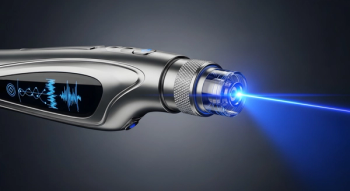
Artist’s conception of a futuristic laser-based instrument ©  MD AL AMIN-chronicles-stock.adobe.com
Raman spectroscopy is shedding its bulky, benchtop reputation as chip-scale spectrometers, tip-enhanced probes, and AI-native detectors push the technique into pockets, production lines, and single molecules. The result is an instrument category being rebuilt from the optics up, faster, smaller, deeper, and smarter than the Raman systems of even five years ago.