Register Now: Advances in Spectroscopy for Pharma and Biopharmaceutical Analysis Symposium
|Articles|May 1, 2003

Spectroscopy

  • Spectroscopy-05-01-2003

PittCon 2003 Review: The 18th Annual Wrap-up of New Spectroscopy Instrumentation Introduced at the Pittsburgh Conference (PDF)

Spectroscopy?s annual overview presents new instrumentation that was introduced at the Pittsburgh Conference and Exposition on Analytical Chemistry and Applied Spectroscopy (PittCon), held this year March 10?13 in Orlando, Florida.


Related to this article

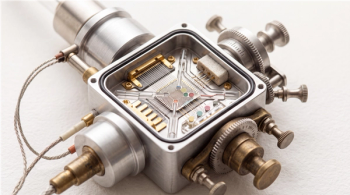
Optical and Electronic Instrument Components,  ©  ridwan -chronicles-stock.adobe.com
The updated and expanded 2026 edition of Spectroscopy's Instrument Components Terminology Guide defines the sources, detectors, optical and dispersive elements, sampling hardware, physical constants, and unit conversions used across UV-vis, NIR, IR, Raman, X-ray, and atomic spectroscopic instrumentation, with new terms reflecting component developments reported between 2022 and 2026.
Pittsburgh, Pennsylvania, USA. Beautiful Pittsburgh at twilight. | Image Credit: © checubus - stock.adobe.com
Organized by CPACT, the April 27 to 29 meeting at the Marriott Pittsburgh City Center will bring together scientists, engineers, and vendors across the process industries, with keynotes on PAT, Raman, and NIR applications and an abstract deadline of December 7, 2026.
Curated 2026 Evergreen Content from Spectroscopy. ©  Chanakarn -chronicles-stock.adobe.com
Spectroscopy's editors gather 143 evergreen articles from 2026, including tutorials, terminology guides, technique reviews, application surveys, peer-reviewed research and the magazine's long-running columns, and organize them by subject so readers can build lasting knowledge one topic at a time.
Atoms Don't Lie–The Remaking of Atomic Spectroscopy, © Hallie -chronicles-stock.adobe.com
Atomic spectroscopy has quietly gone from counting elements in bulk to counting single nanoparticles, imaging tissue at the micrometer scale, and reading Martian rocks from several meters away. The instruments got smaller, the software got smarter, and the questions they can now answer got a lot more interesting.