Special Issues
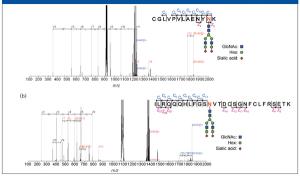
The authors discuss the use of electron-capture dissociation coupled with a linear ion trap time-of-flight mass spectrometer to investigate the structure of human transferrin.
Masaki Watanabe is with Hitachi High-Technologies, Hitachinaka, Ibaraki, Japan.
Special Issues
The authors discuss the use of electron-capture dissociation coupled with a linear ion trap time-of-flight mass spectrometer to investigate the structure of human transferrin.
Special Issues
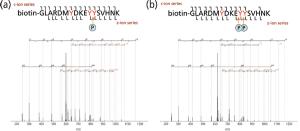
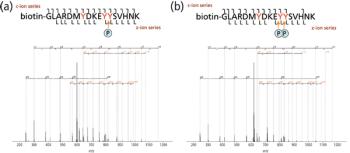
The authors introduce a compact ECD device coupled to a linear ion trap time-of-flight instrument, and use it to analyze protein phosphorylation in both offline and online modes.
Special Issues
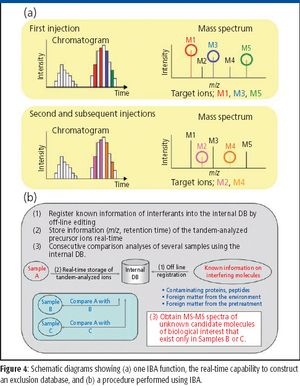
Mass spectrometers are effective for identifying and quantifying unknown molecules, such as disease-related proteins and small molecules in pharmaceutical research and medical diagnosis. In addition, mass spectrometry (MS) can be particularly powerful when analyzing molecules with complex structures, such as posttranslationally modified proteins. Among various MS approaches, high-resolution multistep tandem MS (MS-MS) is an emerging methodology for accurate identification of complex molecules. In this article, we describe a new approach for mass analysis with enhanced quantitative capability combined with high-resolution multistep MS-MS, where the dynamic range of quantitation covers four orders of magnitude.