
Spectroscopy
How much lead is in our daily lives? We take a look at current research concerning lead in the United States food supply and investigations using ICP-MS into the measurement of high concentrations of lead in food.
Spectroscopy
How much lead is in our daily lives? We take a look at current research concerning lead in the United States food supply and investigations using ICP-MS into the measurement of high concentrations of lead in food.

Spectroscopy
Calibration transfer involves multiple strategies and mathematical techniques for applying a single calibration database to two or more instruments. Here, we explain the methods to modify the spectra or regression vectors to correct differences between instruments.

Spectroscopy
With methods such as infrared, Raman, and LIBS, the spectral background contains a wealth of information about material properties of the sample. Now, such information can be derived by artificial intelligence and machine learning algorithms.
Spectroscopy
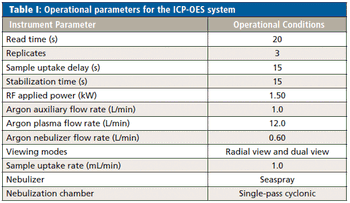
This method demonstrates that ICP-OES is a suitable alternative to ICP-MS for the determination of rare earth elements in geological and agricultural samples
Spectroscopy
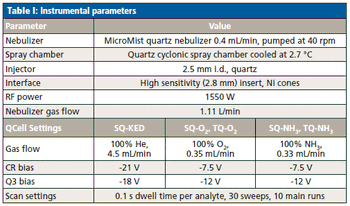
Unresolved interferences can lead to biased results in ICP-MS analyses. Here we describe an approach for removing those interferences using reactive gases.
Spectroscopy
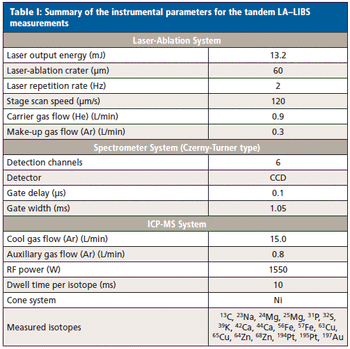
This method demonstrates the excellent suitability of a multimodal approach that combines LA-ICP-MS with LIBS for the analysis of tumor samples, particularly when the standalone techniques cannot detect all the elements of interest.
Spectroscopy
Over the past decade, benchtop nuclear magnetic resonance instruments have been used in the petroleum and petrochemical industries for process control applications.

Spectroscopy
Click the title above to open the Spectroscopy October 2017 regular issue, Vol 32 No 10, in an interactive PDF format.