|Articles|December 1, 2009

Spectroscopy

  • Spectroscopy-12-01-2009
  • Volume 24
  • Issue 12

Market Profile: Process FT-NIR

Fourier transform–near infrared (FT-NIR) spectroscopy is one of a number of molecular spectroscopy techniques that are already used for online process analysis across a number of industries, but are still seeing significant growth in demand. FT-NIR technology has a number of inherent advantages for online analysis.

Fourier transform–near infrared (FT-NIR) spectroscopy is one of a number of molecular spectroscopy techniques that are already used for online process analysis across a number of industries, but are still seeing significant growth in demand. FT-NIR technology has a number of inherent advantages for online analysis.

Process FT-NIR demand by industry in 2009.

The combination of the FT analysis method and the NIR spectrum combine to make FT-NIR a very useful online analytical tool. The use of the FT technique allows for instantaneous analysis of the entire spectrum of a broadband light source, rather than having to scan across the spectrum of interest or use only a single point of the electromagnetic spectrum for analysis. This is ideal for providing detailed analytical information of continuously flowing or changing processes. Although not as sensitive as mid-IR spectroscopy, NIR spectroscopy allows for deeper penetration of the sample, and is better for bulk materials.

Online FT-NIR is used most heavily in refineries and general chemical facilities due to its strength in the analysis of petrochemical compounds. A rapidly growing niche is in the development of alternative biofuels. The global market for process FT-NIR is well over $20 million annually, and is expected to see mid-to-high single-digit growth.

The foregoing data was based upon SDi's Market Analysis & Perspectives (MAP) report program. For more information, contact Stuart Press, Senior Consultant, Strategic Directions International, Inc., 6242 Westchester Parkway, Suite 100, Los Angeles, CA 90045, (310) 641-4982, fax: (310) 641-8851, www.strategic-directions.com.

Articles in this issue


Related to this article

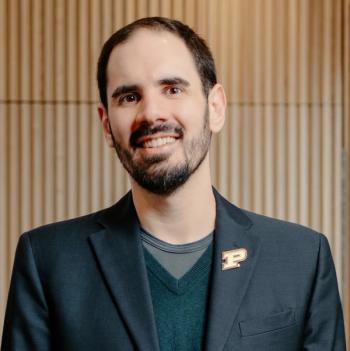
Brandon E. Boor is the Dr. Margery E. Hoffman Associate Professor in the Lyles School of Civil and Construction Engineering at Purdue University. | Photo Credit: © Brandon Boor.
In the second part of our interview with Brandon Boor of Purdue University, he discusses how his team controls experimental variables during cleaning experiments in order to obtain interpretable data.
Scientist With Portable Spectrometer in Natural Field Setting ©  By Tika -chronicles-stock.adobe.com
The bulky bench-top NIR spectrometer is quietly being dismantled and rebuilt as a wafer-scale photonic chip, a self-calibrating algorithm, and a sensor small enough to ride in a shirt pocket. What once demanded a grating, a moving mirror, and a climate-controlled lab now fits inside a handheld module, a bioreactor probe, or a drone payload, and it increasingly figures out what it is looking at on its own.
Sizing Up the Nanoscale: Measuring Nanocluster Aerosol in Indoor Air
In the first part of a multi-part Q&A, Brandon Boor, the Dr. Margery E. Hoffman Associate Professor in the Lyles School of Civil and Construction Engineering at Purdue University, describes the instrumentation and methodology behind measuring nanoparticle size distributions at the nanocluster scale (1–3 nm) and outlines the technical challenges of acquiring reliable, real-time data at these dimensions.