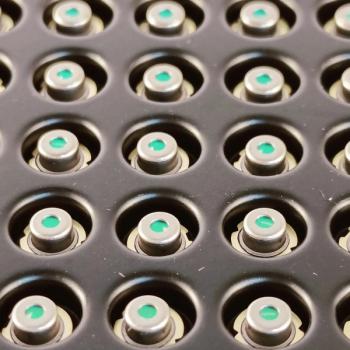
The ability to accurately measure milk composition is crucial for dairy quality control, ensuring product consistency, and optimizing feed management. The ProxiScout™ handheld NIR scanner provides a rapid, cost-effective, and non-destructive solution for on-site milk analysis. This study evaluates the accuracy and performance of ProxiScout™ in predicting fat, protein, and lactose content in raw milk samples, demonstrating its alignment with ICAR standards.
How has spectroscopy training changed? A recent panel discussion explored this topic, discussing how SpecAcademy can widen access without losing the value of hands-on instruction.
FT-IR spectroscopy, long treated as a mature bench technique for confirming a carbonyl stretch or fingerprinting a polymer, has quietly become one of chemistry’s most versatile discovery engines: it now infers molecular structure straight from a spectrum without a reference library, resolves chemistry tens of nanometers wide, and screens a fingerstick of blood for disease in minutes. The last five years of published research show FT-IR moving from a confirmatory tool into a predictive, autonomous, and field-ready analytical platform.
In this panel discussion, five SpecAcademy instructors examined why spectroscopy expertise has declined and how SpecAcademy aims to rebuild it through curated, fundamentals-based education suited to increasingly complex analytical work.
The agreement gives North American customers a stocked, domestic source for InGaAs PIN photodiodes and avalanche photodiodes from the Scottish manufacturer.
Panelists from the Society for Applied Spectroscopy, the Coblentz Society, Syensqo, Specac, and the University of Georgia discuss how a mismatch between academic curricula and industry practice leaves many analysts unsure when, and how, to use infrared and Raman spectroscopy.