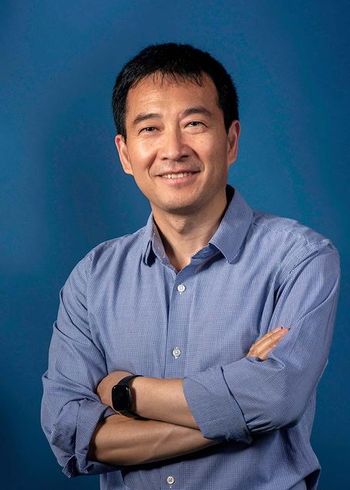
An upcoming interview with Ji-Xin Cheng, a Theodore Moustakas Distinguished Professor in Photonics and Optoelectronics at Boston University, will highlight his ongoing work in coherent Raman scattering microscopy.
In this “Pathways in Spectroscopy” episode, Jennifer Ferguson, an Applications Manager at Renishaw, discusses what she does in her role and types of projects she gets involved in.
“Pathways in Spectroscopy” is an ongoing video series that highlights some of the different career paths spectroscopists can take. This series offers practical, actionable career insights that empower young spectroscopists to take bold pursuits in the career field they desire.
In this episode of “Pathways in Spectroscopy,” Jennifer Ferguson, an Applications Manager at Renishaw, discusses what she does as an Applications Manager for an instrument manufacturer. Ferguson recently delivered a talk at Spring SciX, and this interview was part of our coverage of the conference.1,2
Spectroscopy: Would you be able to talk about what your day to day looks like as an Applications Manager at Renishaw?
Jennifer “Jenny” Ferguson: It's really difficult to talk about a typical day to day, but as the Applications team, we do a large variety of different tasks. It's a very, very varied job, which makes it super interesting, and means that you're always learning new skills, which is nice. We are very much at the forefront of being customer facing, so we do a lot of sample analysis and demos. Because Raman spectroscopy can be applied to so many different areas, we do get a wide range of application areas as well to investigate, and we all get to dabble a little bit in different things, which keeps it really interesting for us. We also do a lot of customer training everywhere from people who have just got our systems that are brand new to Raman to people that have had our systems for many, many years and are extremely experienced, and we have to give them additional training as well. We get involved in a lot of different applications development areas as well, so new areas where we think that Raman would be really good or Raman is essentially establishing within that area. So, for example, I'm doing a lot of work in batteries at the moment because it's kind of obviously a key area, but also things like microplastics. So we did a collaboration with MonPlus, looking at microplastics in drinking water from a from a water company in Denmark. So that was really interesting as well. So, as I say, we do a lot of different stuff, but we also do product and software development, so looking at our current products and how they're being used, and looking at how we can develop them and develop new products as well.