SPEC PerkinElmer 11.10
|Articles|October 1, 2012

Spectroscopy Supplements

  • Special Issues-10-01-2012
  • Volume 0
  • Issue 0

Products

Products

TOF mass spectrometers

The Xevo G2-S QTof and Xevo G2-S Tof benchtop time-of-flight mass spectrometers from Waters are designed with the company's StepWave ion optics and off-axis ion source technology. According to the company, the systems are as much as 20× more sensitive than earlier generation instruments and critical components stay clean longer. Waters Corporation, Milford, MA;

www.waters.com

Card extraction LC–MS system

Agilent's automated card extraction LC–MS system is designed as an integrated instrument for the analysis of dried blood spots and other dried media. The system reportedly incorporates the company's 6400 Series triple-quadrupole LC–MS system and is suitable for pharmaceutical and clinical research laboratories. Agilent Technologies, Santa Clara, CA;

www.agilent.com

MS instrument control software

Thermo Fisher Scientific's instrument control software for its Q Exactive high performance quadrupole-Orbitrap LC–MS-MS system is designed to allow the instrument to collect MS-MS spectra on ions in a sample by selecting broad mass-to-charge ratio windows and fragmenting all precursors in the window. According to the company, the instrument control software allows users to perform data-independent acquisition and targeted quantification experiments on the same instrument. Thermo Fisher Scientific, San Jose, CA;

www.thermoscientific.com

Mass spectrometers

The EVOQ Qube and EVOQ Elite LC–triple-quadrupole mass spectrometers from Bruker incorporate the company's Advance UHPLC systems. According to the company, both systems have a vacuum-insulated probe heated electrospray ionization source, an atmospheric pressure ionization source, a flat-tuning interlaced quadrupole dual funnel, and software that enables "exception-based data review," which reportedly reduces the error rate for quantitative analysis. Bruker Daltonics, Billerica, MA;

www.bdal.com

Mass spectrometer

The LCMS-8040 triple-quadrupole mass spectrometer from Shimadzu is designed to provide polarity switching at 15 ms and a high speed-scanning rate of 15,000 u/s. According to the company, the instrument's UFsweeper II collision cell design enables MRM transition speeds of up to 5555 MRM/s. Shimadzu Scientific Instruments, Inc., Columbia, MD;

www.ssi.shimadzu.com

High-throughput screening software

LibraryView software from AB Sciex is designed for use in identifying contaminants in food, forensic toxicology samples, and the environment, and can be used for clinical research. According to the company, coupled with its QTRAP and TripleTOF technologies, the software enables acquisition of full-scan MS-MS spectra of compounds or contaminants present in a sample. AB Sciex, Framingham, MA;

www.absciex.com

LC–MS system

The 6550 iFunnel quadrupole time-of-flight liquid chromatography–mass spectrometry system from Agilent is designed to increase TOF sensitivity to low femtogram levels. According to the company, the system delivers acquisition to 50 spectra/s and up to five orders of intrascan dynamic range. Agilent Technologies, Santa Clara, CA.

www.agilent.com

Portable GC–MS system

The Tridion-9 portable GC–toroidal mass spectro-metry system from Torion is designed for field GC–MS applications. The system reportedly combines an electronic pressure controlled gas chromatograph with an amplitude scanning toroidal ion trap mass spectrometer. According to the company, the system can be used with SPME syringes for sample introduction. Torion Technologies Inc., American Fork, UT;

www.torion.com

Related to this article

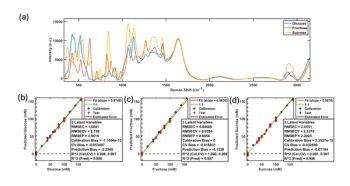
Monitoring Sugar Consumption and Ethanol Production During Yeast Fermentation Using a Raman Plate Reader and Multivariate Analysis
This column shows that a Raman plate reader paired with partial least squares regression can simultaneously quantify glucose, fructose, sucrose, and ethanol in yeast fermentation samples, using turbidity-matched calibration standards to correct for yeast-induced turbidity, and offers a rapid, label-free, high-throughput method for tracking sugar consumption and ethanol production in strain screening, media optimization, and process development.
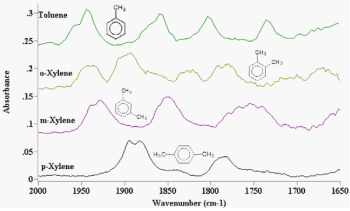
Highly Substituted Benzene Rings—The Rest of the Story II: Spectra
This column, the second installment on highly substituted benzene rings, shows that tri- and tetra-substituted substitution patterns can be distinguished by whether the ring bending peak is present and by the position of the in-phase aryl C-H wagging peak, which shifts according to how many adjacent hydrogens the ring carries.
Healthcare administrator reviewing an insurance policy schedule with a stethoscope on a clipboard, health insurance coverage, medical underwriting, prior authorization, and patient claims processing. | Image Credit: Joi_studio - stock.adobe.com
In a SciX interview, Marc Porter covered a lot of ground, from a student-driven pivot into immunoassays to a baseball analogy for Stokes and anti-Stokes scattering, and shares the open questions he is still chasing.
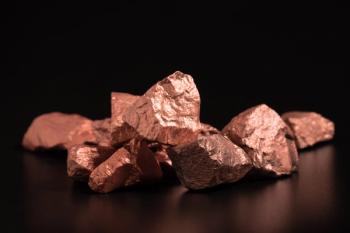
Ingots of pure copper or pink gold on a black background. | Image Credit: Phawat - stock.adobe.com
At SciX, Kevin Wilkinson of the Universite de Montreal explains how faster data acquisition and new software have cut analysis time and how a particle’s chemical composition can link arsenic-bearing emissions back to a copper refinery’s processes.
Spectral Frontiers: Seeing the Unseeable Microspectroscopy
Microspectroscopy, the marriage of spectroscopic chemical identification with microscopic spatial resolution, has advanced from Perkin-Elmer's first commercial infrared microspectrometer in 1953 to today's nanoscale AFM-IR probes, synchrotron-brightness infrared beamlines, and compact hyperspectral tissue imaging devices being developed for AI-assisted cancer detection.