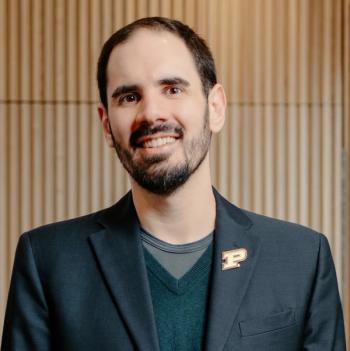
In the second part of our interview with Brandon Boor of Purdue University, he discusses how his team controls experimental variables during cleaning experiments in order to obtain interpretable data.
For 30 years, Spectroscopy has provided its readers with valuable content, advice, troubleshooting tips, and insight to many areas of materials analysis. Our mission statement says
For 30 years, Spectroscopy has provided its readers with valuable content, advice, troubleshooting tips, and insight to many areas of materials analysis. Our mission statement says
Spectroscopy's mission is to enhance productivity, efficiency, and the overall value of spectroscopic instruments and methods as a practical analytical technology across a variety of fields. Scientists, technicians, and laboratory managers gain proficiency and competitive advantage for the real-world issues they face through unbiased, peer-reviewed technical articles, trusted troubleshooting advice, and best-practice application solutions.
I believe we have lived up to that mission statement very well during the past three decades, but it would not have been possible without the invaluable work of our columnists, peer-reviewed authors, editorial advisory board, advertisers, and, of course, the editorial and sales staff at Spectroscopy-both past and present. In honor of our 30th anniversary celebration this month, I would like to say thank you to everyone that has contributed to Spectroscopy over the years. I'd also like to extend a thank you to our readers, who always push us to do better and provide the best content to meet their specific needs.
Our magazine is a staple in the spectroscopic community because of the hard work and dedication of our staff and contributors. Below you will find photos of the terrific and hard-working staff at Spectroscopy. Please feel free to say hello to us at conferences and industry events.
Thank you again to everyone who has been a part of this publication. Here's to the next 30 years!
Michael J. Tessalone
Science Group Publisher
Michael J. Tessalone
over 11 years ago
Choosing the Best Regression Modelover 11 years ago
Analysis of the State of the Art: Raman Spectroscopyover 11 years ago
Current Uses of Raman Microscopy in Biomedical Studiesover 11 years ago
From the Editorover 11 years ago
Analysis of the State of the Art: Infrared Spectroscopyover 11 years ago
Analysis of the State of the Art: XRFover 11 years ago
Analysis of the State of the Art: LIBSover 11 years ago
App of the Month: Optics Physicsover 11 years ago
Analysis of the State of the Art: ICP-MS