Agilent

Articles by Agilent

Watch this 20-minute educational video by Andreas Kerstan, Agilent Product Specialist in molecular spectroscopy, to gain a comprehensive update on the microplastics landscape and the environmental concerns related to them. Discover the current challenges in microplastics characterization and how Agilent innovative solutions and techniques, including FTIR, LDIR, GC/MS, and ICP-MS, are addressing these issues head-on.

It is estimated that more than 75% of the 8.3 billion metric tons of plastic produced over the last 65 years have turned into waste. Up to 13 million metric tons of this waste ends up in the ocean every year and recent calculations estimate that more than 5.25 trillion plastic particles float in the world’s oceans. Scientists have demonstrated the alarming environmental ubiquity and persistence of particulate plastic in aquatic ecosystems. Models predict that approximately 14% of the plastic debris in the ocean surface layer can be classified as so-called microplastics (often referred to as particles between 1 µm and 5 mm in size). These ingestible and potentially harmful particles have been formed by UV-induced, mechanical, or biological degradation of larger debris items. To verify the estimates and to meet upcoming regulatory measures (e.g., California Senate Bill 1422) and directives (MSFD, 2008/56/EC), accurate, time-efficient, and robust analytical workflows and techniques are required.

Plastic pollution has become a high-priority area of study in recent years due to the increasing prevalence of plastics in the environment. Currently, researchers have a limited understanding of the impact of plastic pollution on human health, how it affects wildlife and their habitats, and its long-term effects on the environment. An important step in overcoming this pressing global environmental issue is the advancement of research relating to the identification of plastic waste and microplastic particles.

During the invention, development, and early production phases of synthetic plastics, only small quantities were produced, and dealing with waste-plastic was relatively controllable. Over the last few decades, however, plastic production has been growing faster than the production of any other materials. Nowadays, an estimated 400 million tons of plastic waste is produced every year, and a large portion of this waste ends up in the natural environment.

In the years since Agilent released the first triple quadrupole inductively coupled plasma mass spectrometer (ICP-QQQ), the company’s instruments have been used for several novel applications. Case studies at Ghent University and an interview with Source Certain help demonstrate the full potential of this technology.

Source Certain use both Agilent ICP-MS (single and triple quadrupole versions) and Agilent ICP-OES instruments. Source Certain have six Agilent atomic spectroscopy instruments in their new state-of-the-art lab. Their new 8900 ICP-QQQ is allowing them to see things they have never seen before in the samples, with some detection limits at parts-per-quadrillion levels.

Source has been using Agilent equipment since 2010, so selecting another Agilent instrument was an easy choice. They currently have three Agilent ICP-OES instruments from three different generations, the 700 series, a 5110, and the most recent a 5900, all with autosamplers.

AgSource analyzes from 2,000 to 6,000 samples in a day, depending on the time of the year. Accuracy is critical for AgSource. Time and time again, they want to be as accurate as possible and be able to reproduce that accuracy with those same samples that come in over time.

Product origin and production claims, like sustainable and ethical sourcing, are vital information for consumers. It’s not just the product that matters anymore but also the promise. These promises are becoming as important, in some situations, more important than price and other product features.

Learn how PFAS, microplastics, and chromium detection in environmental samples can be greatly enhanced with the latest LC-MS, laser directed IR spectroscopy, and IC-ICP-MS technologies

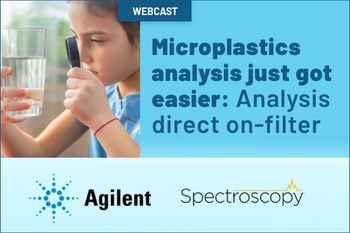
Microplastics analysis just got easier: Analysis direct on-filter

North America: Wednesday, November 16, 2022 at 11am PST | 1pm CST | 2pm EST Europe: Thursday, November 17, 2022, at 11am BST | 12pm CET Asia: Thursday, November 17, 2022, at 10:30 IST | 1pm SGT | 2pm JST | 4pm AEST Fast, easy, and accurate analysis of microplastics is a key need of anyone with an interest in this area. With the capacity to conduct this analysis directly on the filter in the Agilent 8700 LDIR for microplastics, this analysis has now reached a new level.