
Sponsored Content
The determination of mercury concentrations in environmental samples such as natural waters and wastewaters is important in environmental risk assessment.
Sponsored Content
The determination of mercury concentrations in environmental samples such as natural waters and wastewaters is important in environmental risk assessment.
Analytik Jena’s high-resolution ICP-OES with high sensitivity complies with concentration limits of drinking water regulations with no requirement of further accessories.
Sponsored Content
A species-unspecific response of high-resolution continuum source graphite furnace molecular absorption was developed for the determination of a sum parameter of fluorinated compounds.
Sponsored Content
Since antigens used in pharmaceutical vaccine production typically consist of proteins, the analytical quantification of total protein is a method of choice.
Sponsored Content
The PlasmaQuant® MS allows for direct determination of all elements within a single routine analysis using ICP-MS with all-digital detection technology.
Sponsored Content
HR ICP-OES with high-resolution optical system, superior sensitivity, matrix tolerance achieves lowest LOD for trace element analysis in complex water-alcohol-oil samples
Sponsored Content
HR ICP-OES with high-resolution optical system, superior sensitivity, and matrix tolerance achieve sub-ppb detection limits for trace element analysis in saline matrices
Sponsored Content
This application note demonstrates how the PlasmaQuant MS provides low detection limits, accurate results and long-term stability analyzing volatile solvents.
Sponsored Content
This application note describes a how to achieve quantitative digestion of lactic acid without soot formation in the shortest measurement time.
Sponsored Content
This application note describes a reliable and fast method for the separation of more than five As species by coupling a PQ LC HPLC system and a PlasmaQuant® MS, ICP-MS.
Sponsored Content
This application note describes different application methods for the fast and reliable determination of widely varying sulfur contents.
Sponsored Content
The determination of mercury concentrations in environmental samples such as natural waters and wastewaters is important in environmental risk assessment.

Analytik Jena’s High-resolution ICP-OES with high sensitivity complies with concentration limits of drinking water regulations without further accessories required.
Sponsored Content
This note describes how to acquire reproducible, reliable determination of total organic carbon (TOC) content in drinking water providing a high inorganic-carbon matrix.
Sponsored Content
This application note describes the analysis of heavy metals in cannabis with high sensitivity, precision, and accuracy using HR ICP-OES.
This application note describes quantitative digestion of biofuel samples and their precursors without soot formation in the shortest measurement time.
Using Analytik Jena’s patented iCRC technology for interference removal, we measured 82 drinking water samples per h with 21 elements (+4 internal standards).
Analytik Jena’s High-resolution ICP-OES with high sensitivity complies with concentration limits of drinking water regulations without further accessories required.
Sponsored Content
Application of HR-CS Flame AAS for determination of macro-micro and ultra-micro element contents using only one dilution factor in a single measurement run.
Sponsored Content
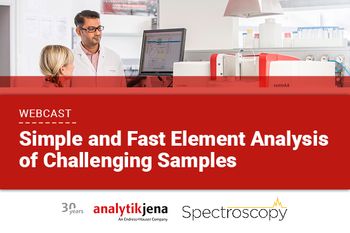
Discover how modern AAS technology can make routine analysis of challenging samples more efficient for your lab. Atomic spectrometry expert Anja Jungnickel explains in our exclusive webcast. Live: Thursday, October 8, 2020 11am EDT | 8am PDT | 4pm BST | 5pm CEST On demand available after airing until Oct. 8, 2021
Analytik Jena’s patented iCRC technology for interference removal demonstrates the measurement of 82 drinking water samples per h with 21 elements (+4 internal standards).
This application note describes a method for determining the composition of mullite and fiber cement as conducted by an on-site wet-chemical process laboratory.
Sponsored Content
This application note describes HR ICP-OES with high-resolution optical system, superior sensitivity and matrix tolerance to achieve lowest LOD for trace element analysis in complex water-alcohol-oil samples
Sponsored Content
This application note demonstrates how the PlasmaQuant MS provides low detection limits, accurate results and long-term stability analyzing volatile solvents.
Sponsored Content
Reliable TOC analysis using the NPOC method with TIC control, high throughput by parallel purge and analysis, comparing catalytic combustion with UV-chemical oxidation.
Sponsored Content
Sponsored Content