

Researchers used complementary spectroscopic techniques and computational modeling to investigate how glycerol affects cysteamine dioxygenase (ADO)’s active site, substrate binding, and broader physiological roles in metabolism and oxygen sensing.

Brad Pierce was born in Loveland, Colorado, and moved to Sacramento, California, in 1989. He earned a B.S. in Chemistry with a minor in Biology from California State University, Chico, and began his scientific career as a research associate at Matrix Pharmaceuticals, where he contributed to the development of gel-based cisplatin formulations for cancer therapy. He went on to earn his Ph.D. in Chemistry from Carnegie Mellon University under the mentorship of Professor Michael Hendrich, employing advanced EPR spectroscopic methods to study transition metal complexes and metalloproteins.
Following his doctoral studies, Pierce conducted NIH-funded postdoctoral research with Professor Brian Fox at the University of Wisconsin, where he investigated the mechanisms of non-heme iron metalloproteins and the role of protein-protein interactions in modulating enzymatic reactivity. He launched his independent career in 2008 as an Assistant Professor of Chemistry & Biochemistry at the University of Texas at Arlington, where he was promoted to Associate Professor in 2014. In 2019, he joined the faculty at the University of Alabama, where he advanced to the rank of Professor in 2025.
Researchers used complementary spectroscopic techniques and computational modeling to investigate how glycerol affects cysteamine dioxygenase (ADO)’s active site, substrate binding, and broader physiological roles in metabolism and oxygen sensing.
Can thiol dioxygenase be a uniquely dual-function enzyme that links metabolism and oxygen sensing?
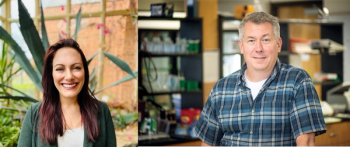
Spectroscopy sat down with Molly Lockart and Brad Pierce to discuss their group’s work with pulsed electron paramagnetic resonance (EPR) spectroscopy to improve our understanding of enzyme dysfunction and the mechanism of sulfur-oxidation.
