
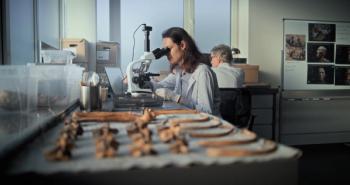
In this brief Q&A, Christina Ryder, who is a postdoctoral researcher at Texas A&M University and the lead author of this study, explains the remaining limitations in using NIR spectroscopy for collagen prediction.

Christina Macie Ryder is a postdoctoral researcher at the Center for the Study of the First Americans in the Department of Anthropology at Texas A&M University. Her work develops and refines non-destructive screening methods to optimize sampling for radiocarbon, stable isotope, and paleoproteomic analyses, with applications to Late Pleistocene megafaunal and archaeological assemblages across North America, Eurasia, and Africa. She earned her Ph.D. in Biological Anthropology from the University of Colorado Boulder, where her dissertation, Saving Old Bones, established NIR spectroscopy as a predictive tool for evaluating collagen preservation in archaeological bone. At the Center for the Study of the First Americans, she leads NIR prescreening and radiocarbon sampling within a large-scale radiocarbon dating project investigating the timing of Late Pleistocene megafaunal extinctions.
In this brief Q&A, Christina Ryder, who is a postdoctoral researcher at Texas A&M University and the lead author of this study, explains the remaining limitations in using NIR spectroscopy for collagen prediction.
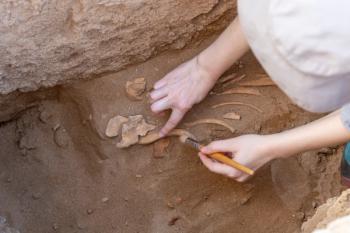
In this brief Q&A, Christina Ryder, who is a postdoctoral researcher at Texas A&M University and the lead author of this study, explains why restricting sampling to the 2030–2060 nm spectral region was key in avoiding interference from consolidants.
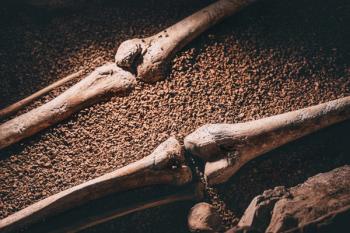
In this brief Q&A interview, Christina Ryder, who is a postdoctoral researcher at Texas A&M University and the lead author of this study, discusses her team’s findings.

Christina Ryder, a postdoctoral researcher at Texas A&M University, discusses the current limitations of using near-infrared (NIR) spectroscopy for collagen prescreening on archaeological bone.
What is the impact of portable spectroscopy on archaeology? Christina Ryder, a postdoctoral researcher at Texas A&M University, addresses this question in this interview.
What is the issue with percent nitrogen analysis when analyzing collagen in archaeological bone? Christina Macie Ryder, a postdoctoral researcher at Texas A&M University, explains the main problem.
Studying archaeological bone is important to learning more about the historical biological record that artifacts alone cannot tell us. Christina Ryder, a postdoctoral researcher at Texas A&M University, explains how to obtain the best collagen signals when studying archaeological bones.
What predictive modeling strategy works best for radiocarbon dating? According to Christina Macie Ryder, a postdoctoral researcher at Texas A&M University, random forest (RF) models perform better than other modeling strategies such as partial least squares regression (PLSR).
Why is near-infrared (NIR) spectroscopy a more useful technique when studying archaeological bone? According to Christina Macie Ryder, a postdoctoral researcher at Texas A&M University, it comes down to the penetration depth.

April 9th 2026