SPEC PerkinElmer 11.10
|Articles|April 25, 2017

Blink and You Miss It—Catching Fleeting Catalytic Intermediates by High-Speed 785 nm NIR Raman Spectroscopy

Author(s)Cobolt

It is only in the last two decades that Raman spectroscopy has begun to realize its potential as an almost universally applicable analytical technique from materials and life sciences applications to point of care analysis. This is primarily thanks to the availability of compact laser sources, high sensitivity cameras and high resolution compact spectrometers. In this application note the use of a stable high power NIR 785 nm laser is shown to be critical in achieving high time resolution and high signal to noise ratios while allowing for both fast and slow processes to be captured simultaneously.


Related to this article

Monitoring Sugar Consumption and Ethanol Production During Yeast Fermentation Using a Raman Plate Reader and Multivariate Analysis
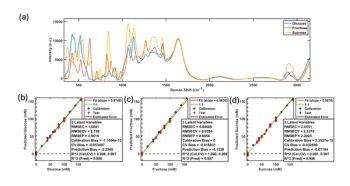
This column shows that a Raman plate reader paired with partial least squares regression can simultaneously quantify glucose, fructose, sucrose, and ethanol in yeast fermentation samples, using turbidity-matched calibration standards to correct for yeast-induced turbidity, and offers a rapid, label-free, high-throughput method for tracking sugar consumption and ethanol production in strain screening, media optimization, and process development.
Highly Substituted Benzene Rings—The Rest of the Story II: Spectra
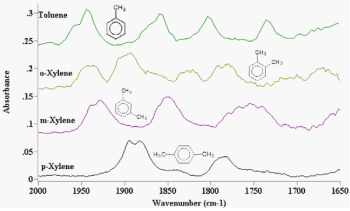
This column, the second installment on highly substituted benzene rings, shows that tri- and tetra-substituted substitution patterns can be distinguished by whether the ring bending peak is present and by the position of the in-phase aryl C-H wagging peak, which shifts according to how many adjacent hydrogens the ring carries.