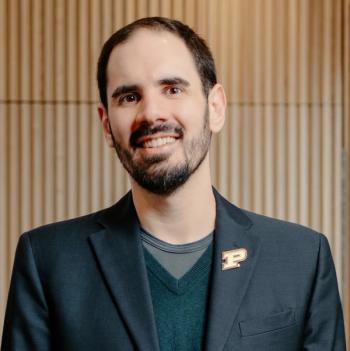
In the final part of our conversation with Brandon Boor of Purdue University, he explains the respiratory deposition model his team used to analyze indoor particle exposure.
In this interview segment, Miguel Sanz-Novo, an Alexander von Humboldt Fellow at the Max Planck Institute for Extraterrestrial Physics, discusses why complex organic molecules are important to study.
Miguel Sanz-Novo, who an Alexander von Humboldt Fellow at the Max Planck Institute for Extraterrestrial Physics, discussed his research on complex organic molecules (COMs) and sulfur-bearing molecules in star-forming regions as part of our coverage of the
Sanz-Novo explained that complex organic molecules, which are carbon-based compounds containing six or more atoms, are of particular interest because some are considered precursors to the fundamental building blocks of life. By detecting molecules such as glycolamide, which is an isomer of the amino acid glycine, researchers can gain insight into the chemical inventory present in interstellar environments long before planetary systems emerge. These observations help scientists trace the pathways that lead to increasingly complex prebiotic molecules, including amino acids, nucleic acid components, and even compounds related to phospholipid formation.
According to Sanz-Novo, the chemistry that gives rise to these molecules begins very early in the star-formation process. Material produced in these environments may later be incorporated into planets or delivered through comets, asteroids, and meteorites, potentially supplying young worlds with ingredients necessary for life.
The interview also highlighted the importance of sulfur chemistry in astrochemistry and astrobiology.
One of Sanz-Novo’s notable research findings involves the detection of dimethyl sulfide (DMS) in the interstellar medium. DMS had previously been regarded as a potential biomarker for extraterrestrial life because of its biological origins on Earth. However, the discovery that DMS can form efficiently through abiotic processes in space suggests that it cannot be considered a unique indicator of life. This finding underscores the need for caution when interpreting potential biosignatures and highlights the value of molecular spectroscopy in understanding the chemical complexity of the universe.