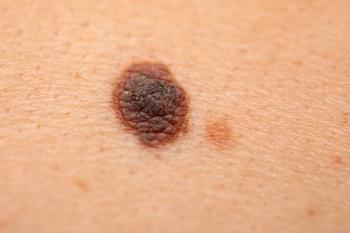
Discover how handheld Raman spectroscopy is helping distinguish skin cancer from normal tissue, courtesy of researchers from Florida Atlantic University.
How has Raman spectroscopy been applied to the development of materials that are important in technology?
Because its properties can be controlled by composition and manufacturing history, glass has been used since the Stone Age when obsidian was chipped to make sharp objects for hunting and cutting. The Romans actually manufactured glass for holding and storing liquids. But we are interested in modern uses, where the physical and chemical properties can be controlled with composition and history. Because of its transparency in the visible region of the spectrum, glass is used for containers, windows, electronic devices, and optics. However, common glasses are quite brittle: They can easily shatter, producing large, sharp shards that can destroy the products’ uses and are quite dangerous. Raman spectroscopy has been used for more than 50 years to follow the changes in the structure of glasses with composition. In this column, we survey what is known and how Raman spectroscopy has been applied to the development of materials important to technology.
Glasses are solid amorphous materials without the long-range order of crystals. They are often formed by melt-quenching a supercooled liquid, and the ability to form a glass during rapid cooling is known as its glass-forming ability. Although glasses can be formed from a variety of metal oxides (or even sulfides), we will consider silicate-based glasses here. Valence considerations determine that each silicon atom is bound to four oxygen atoms, but the angles included at the silicon atoms are distorted from those in crystalline phases. Although pure amorphous silica (SiO2) is a useful material, especially for fiber optics, it is difficult to use for many applications because of its high melting temperature and high fabrication costs. Consequently, many glasses contain alkali and alkaline elements, aluminum, and boron.
As one can imagine, the physical and chemical properties will reflect the elemental composition. Many common glasses based on alkali or alkaline earth elements are susceptible to corrosion. Consequently, CaO, MgO, and Al2O3 are added to improve chemical stability. Boron trioxide (B2O3) is also used to improve glass physical characteristics: it lowers thermal expansion, making it useful for applications where the glass will experience large thermal excursions.
Raman spectra have been measured by many authors to understand the structures that determine the properties. McMillan published extensive spectra of these glasses in the early 1980s, showing composition and polarization dependence.1,2 A more recent publication of the MgO/CaO sodium aluminosilicate glasses follows the Raman spectra as a function of composition3; one of the authors is John Mauro, who was at Corning when the article was published but is now head of the Materials Science and Engineering group at Pennsylvania State University. He continues to collaborate with Corning on the improvements to Gorilla Glass, originally used for cell phone covers in 2007, which will be discussed later in this article.
The spectra of glasses have been interpreted in terms of the connectivity of the glass network. Any SiO2 structure will have four Si–O bonds at each silicon atom when, for example, alkali ions are added to silica, the Si–O–Si bonds are broken, leaving SiONB bonds, where NB denotes non-bridging oxygen. There can be three, two, one, or zero bonding oxygens (BOs). McMillan and Piriou4 in their Figure 4 summarize the Raman behavior for =Si=, ≡SiO, = SiO2, -SiO3, and SiO4; bands appear respectively at 450, 800, and 1050–1250 cm-1; 500–600, 775, and 1050 cm-1; 500–650 and 1000 cm-1; 700 and 900 cm-1; and 850 cm-1. Almeida and Santos denote non-bonding oxygen bands Q3, Q2, Q1, Q0, and these can be followed in the spectra of sodium silicate glasses.5 In Figure 3.4 of Reference 5, Q3 appears near 1100 cm-1 for 60–90% silicate. Q2 appears near 950 cm-1 for 50–70% silicate. Another band between 520 and 650 cm-1 appears for glasses with 50–80% silicate. Figure 3.4 in Reference 5 conveniently illustrates the appearance and shift of these bands in a sodium silicate glass as a function of sodium concentration.
The Raman spectra of alkali borosilicate glasses have been studied by Osipov et al.6 In this system, there are Q4, Q3, (BO4/2]- tetrahedrons, BO3/2 triangles, and BØ2/2O- triangles (at low SiO2 content).
For technology applications such as electronic devices, including cell phone covers, the biggest problem is the susceptibility to fractures. Although the theoretical tensile strength of glass is higher than that of many metals, the presence of microscopic flaws, such as scratches on the surface, leads to susceptibility to fracture. Techniques for toughening have been developed to make glasses robust against fracture.
An early method for toughening glass, especially for car windshields, was to sandwich two glass layers around a layer of polymer with the same index of refraction as the glass. Because of the index match, there are no ghost images. This is called laminated glass. When it breaks, it breaks into granular chunks, which are less likely to cause penetration than jagged shards.
Glass can also be tempered with a thermal tempering process. It is heated above its glass transition temperature and cooled rapidly with forced air drafts so quickly that the inner portion remains molten.
However, the big breakthrough for toughening the glass was to ion-exchange the sodium-containing finished glass piece in a molten alkali salt, such as KNO3, where K+ ions replace Na+ ions at the surface.7 The larger K+ ions produce compression at the surface of plates as thin as 100 µm. Typical conditions are ~475°C for 16 h, making this an expensive process.8 The process was developed at Corning in the early 1960s and used on the original Apple iPhone in June 2007 under the brand name Gorilla Glass. Since its first use, Gorilla Glass has undergone at least 10 generations of improvements, which included the use of glass ceramics in January 2025.9 Glass ceramics are mixtures of crystalline and amorphous phases, which are heat-treated for controlled nucleation and are also resistant to thermal shock because of the thermal expansion coefficient of the crystalline phase being negative and that of the amorphous phase being positive. At approximately 70% crystallinity, the thermal expansion coefficient is close to 0, and the material can tolerate temperature changes up to 1000 °C.
The next section presents representative spectra of several glasses, illustrating how Raman spectroscopy can be useful for characterizing these materials. And then, we show some spectra of Gorilla glasses, indicating the engineering developed to harden them.
Figures 1a and 1b show the Raman spectra of seven glasses and crystalline quartz as examples of the Raman spectra of some of these materials. From top to bottom are spectra of a glass frying pan, a microscope slide, a drinking glass, a small laboratory glass container, then labware, colloidal silica, tetrasil (amorphous quartz) and crystalline quartz at the bottom. The spectra were all acquired with the 532 nm green laser and full-scale spectra are shown in Figure 1a out to 4000 cm-1. Clearly, some of the spectra have significant backgrounds, which will appear different when excited at different wavelengths. Glasses with alkali composition especially will often show these fluorescent backgrounds because of small amounts of iron contamination. To compare spectra, use of a green laser for excitation is recommended if possible. In addition, expansion of the spectrum of colloidal silica in the 3600 cm-1 region shows clear evidence for OH functionality. The region below 1400 cm-1 for all the glasses is expanded in Figure 1b to more clearly show the differences that reflect their varying compositions.
The spectrum at the top of the figure came from an orange-yellow glass Corning frying pan from my kitchen. One assumes the high background in this case is due to the coloration. We know that a glass destined to be used in cooking will contain B2O3 that stabilizes it against temperature changes, and it will typically have 80% SiO2, 13% B2O3, 4% Na2O or K2O, and 2–3% Al2O3. This spectrum at the top of Figure 1b matches fairly well with Figure 1 in reference 10, which shows a spectrum of a borosilicate glass with 80.54% SiO2, 12.70% B2O3, and 3.54% Na2O (and minor percentages of other components). This is a composition that matches fairly closely the advertised composition of cooking glass listed above. The next two spectra in the figure (microscope slide and drinking glass) are essentially identical. It is known that a microscope slide is usually made of an optically clear soda lime glass or a borosilicate glass known as BK7. In fact, these spectra match that of a soda lime glass similar to those shown in Figure 2 of reference 4. The spectrum of the glass container with two broad peaks centered near 480 and 1070 cm-1 matches closely the spectra in Figures 2 and 3 of reference 3 of the CaO/MgO-Na2O-Al2O3-SiO2 glasses with Al2O3 molar concentration of 10.7%, SiO2 concentration at 65.2–65.3%, Na2O concentration at 15.7-15.8% and CaO or MgO 8%. Note that Figures 2 and 3 of reference 3 show that at these concentrations the spectrum of the Ca-containing glass is quite similar to that of the Mg-containing glass.
The next spectrum down on the plot was acquired from labware, which is nominally PYREX. This spectrum matches quite well that of a borosilicate glass with 80.54% SiO2, 12.70% B2O3, 3.54% Na2O, 0.64% K2O, and 2.53% Al2O3 composition shown in Figure 1 of reference 10.
The next spectrum down was acquired from a bottle labeled colloidal silica and is quite similar to the spectrum of amorphous silica shown next to the bottom. There are some significant differences, however. The defect bands in silica near 490 and 610 cm-1 are absent in the colloidal silica spectrum. Figure 1a shows the OH region of the colloidal silica spectrum expanded in order to see clearly OH bands between 3550 and 3800 cm-1. This makes sense when one realizes that colloidal silica would have been a gel dispersed in water and then dried by one of several methods. The bottom spectrum of my Figure 1 shows the spectrum of crystal quartz, which indicates how much sharper the bands of the crystalline form are.
In summary, the spectra in Figure 1 indicate that the Raman spectra even of amorphous materials with broad bands can be useful in estimating the composition of glasses. Unfortunately, I do not have a set of glasses of known composition that I could have measured for identification purposes, so if you are going to use Raman spectra to study glasses, I recommend that you acquire the publications that I have cited, as well as others of relevance.
Having established that Raman spectra can be used to identify commercial materials, I wanted to measure Gorilla Glass and confirm what the literature says is the origin of the mechanical strength. However, since I do not have access to materials except in my Horiba (iPhone 14) and personal (iPhone 15) phones, and I did not want to peel off the protection cover, I looked for a way to measure the phone’s glass in situ.
Figure 2 shows the results of measuring a depth profile of the glass next to the protector on the front face of my iPhone 14. On the bottom right are the spectra that I extracted using classical least squares (CLS). Although multiple curve resolution (MCR) is often useful in this case, I could see the glass spectrum changing as I surfed the file, but the changes were too subtle to be captured by MCR. It appeared that the thickness of the spectrum of the glass on the top surface was approximately 20 µm. Interestingly, the difference between that spectrum and the spectrum of the bulk glass is subtly different, which may not be too surprising for a soda alkali glass into which potassium had diffused. Note that my goal was only to see evidence for potassium diffusion. If you want to use the spectra to characterize physical characteristics, a more extensive study would be needed. For a start spectra of glasses with known potassium and sodium, the compositions need to be recorded as references, and if you are trying to engineer a glass, you will need to understand what the Raman spectra are saying about the atomic connectivity.
This depth profile has more information. Below the glass layer are layers of two types of polyester. The bottom layer is a classic spectrum of PET (polyethylene terephthalate), but the layer above it has many of the same bands as PET but at drastically different intensities.
Figure 3 shows the results of measuring a depth profile of the glass next to the protector on the front face of my iPhone 15. After measuring the spectrum as a function of depth, this time I used MCR to identify the spectra of the layers. The figure on the bottom right shows the MCR factors, and the depth profiles for each component are shown on the top left. At approximately 100 µm below the top, the intensities of the PET on top and an inorganic crystalline phase are about equal. At the bottom of the profile (approximately 400 µm below the top), there is a spectrum of a film of amorphous carbon, something that really surprised me.
Figure 4 shows a depth profile recorded from the circular cover over one of the cameras on a model 14 iPhone. In this case, the depth profile shows that the bulk plate is composed of sapphire and has a glass layer underneath. Actually, my colleague Peng Miao pointed out that sapphire is used for these small plates because it is quite hard and not difficult to manufacture for this size. But use of this material on the front surface of an iPhone would be prohibitively expensive.
The Raman spectra of glasses exhibit bands that are quite broad, but a review of the literature, coupled with some representative spectra, shows that the spectra can be used to differentiate glasses of different compositions. By comparing the spectra of glasses with systematically varying compositions, researchers have been able to characterize the types of bonding in the glass-forming network as composition is varied. Our goal at the beginning of this project was to document the diffusion of potassium into soda alkali glasses for the Gorilla Glass covers of cell phones. However, the technology has been changing rapidly, so we were also able to document the presence of polymers, inorganic crystals, and even carbon films in these protective layers.
I would also like to make some further comments about a unique contemporary use of glass. As of October 2025, site managers at the Hanford Tank Waste Treatment and Immobilization Plant have begun sealing medium- and low-level nuclear waste in glass for storage in stainless steel containers for geological disposal.11 Because radioactive isotopes last for tens of thousands of years, there are significant challenges involved in storing this material. These include chemical durability and impermeability to avoid leaching radioactive elements into groundwater. The composition and method for vitrification have to be engineered to fulfill these requirements. Scientists have been working on this since the 1970s, considering both glasses and ceramics for this purpose.12,13 The cited articles provide a wealth of information on what has been done so far and where in the world ongoing activity is taking place. There is no Raman information in these publications, but the materials engineer who wants to optimize a glass (or ceramic) formula could determine which material parameters are important for this application and then use Raman spectroscopy to characterize what is being made.