
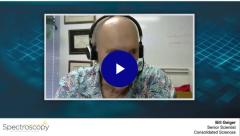
News|Videos|November 27, 2024
The Spectroscopic Techniques Shaping Semiconductor Analysis
The speakers delve into advanced techniques like Fourier-transform infrared spectroscopy (FT-IR) and inductively coupled plasma mass spectrometry (ICP-MS), discussing their strengths and limitations in semiconductor analysis.
Advertisement
Episodes in this series
Advertisement
Related to this article

Panelists from the Society for Applied Spectroscopy, the Coblentz Society, Syensqo, Specac, and the University of Georgia discuss how a mismatch between academic curricula and industry practice leaves many analysts unsure when, and how, to use infrared and Raman spectroscopy.

Gaps in spectroscopy education are costing companies time and money. What are these gaps and how are they being addressed?
Raman spectroscopy is entering one of its most consequential periods since its commercialization, driven by artificial intelligence, coherent heterodyne detection, and radical instrument miniaturization, with new deep-learning frameworks and portable systems moving Raman analysis into fields, factories, and crime scenes.
In this panel discussion, five SpecAcademy instructors sit down to talk about the main reasons SpecAcademy was started and the current state of spectroscopy education.
Top content published this week include a digital e-book to celebrate National Forensic Science Week, a recap of the top 10 articles published in August 2026, and more.

In this Q&A overview, we explore the derivation of principal component analysis using elementary algebra rather than standard matrix notation.

A new review article in Microchimica Acta finds that smartphone-based optical and spectroscopic sensors show strong potential to decentralize food safety testing across contaminants like pesticides, heavy metals, and pathogens.

In the third episode of “Spectroscopy Around the Globe,” we're heading underground and into a hillside in southwestern France to talk about one of the greatest art discoveries of the 20th century: the Lascaux Caves.
Advertisement
Advertisement