News|Videos|March 23, 2026

Translating ATR-FTIR and Machine Learning Nail Analysis

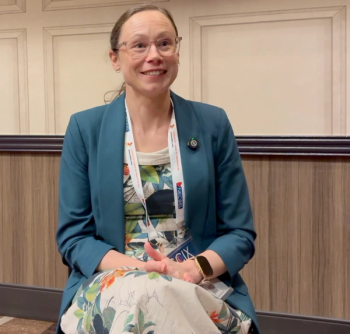
In this interview clip, Lenka Halámková, an assistant professor of high-dimensional data analysis at Texas Tech University, explains the next steps needed in order for attenuated total reflectance Fourier transform infrared (ATR-FTIR) spectroscopy and machine learning to become a part of routine forensic and clinical toxicology workflows for opioid exposure.

Attenuated total reflectance Fourier transform infrared (ATR-FTIR) spectroscopy and machine learning (ML) can become part of forensic and clinical toxicology workflows for opioid exposure, but more work still needs to be done, according to Dr. Lenka Halámková, who is an assistant professor of high-dimensional data analysis at Texas Tech University.

Recently, Halámková presented her team’s findings in a proof-of-concept study at Pittcon 2026 in San Antonio, Texas. Her talk, titled “Multi-Modal Spectroscopic and Biochemical Approaches for Fentanyl Detection: Integrating Raman, ATR-FTIR, and Enzyme Kinetics Analysis,” highlighted the application of ATR-FTIR and Raman spectroscopy in forensic analysis to detect fentanyl.1

Following her talk, we sat down with Halámková to recap the main takeaways of her talk and what her study’s results mean moving forward. Part 1 summarized the key findings and provided an overview into the focus of her team’s study. Part 2 concentrated on ATR-FTIR spectroscopy, and the benefit that using this technique provided when capturing the chemical signatures of fentanyl within the nail’s keratin matrix. Part 3 explored the effectiveness of partial least squares discriminant analysis (PLS-DA) and support vector machine discriminant analysis (SVM-DA) in the study. Part 4 addressed how variables, such as sample size and sample type, influenced the study’s results.


In the final part of our conversation with Halámková, we asked her about the future directions and next steps that need to be taken to build on her team’s proof-of-concept study. We were interested in finding out what was needed to translate ATR–FTIR and machine learning nail analysis into routine forensic or clinical toxicology workflows for opioid exposure monitoring.

In her response, Halámková stressed the need to overcome limitations by increasing sample size and including real-world samples from individuals on various drugs. The goal, she said in our interview, is to develop a more robust method, which will then require the creation of a standard operating procedure (SOP) detailing every step, material, and parameter used.

Spectroscopy will be continuing to provide coverage of the Pittcon 2026 conference on an ongoing basis as we report back from San Antonio. Staying up to date with our coverage of Pittcon 2026 will provide you with increased knowledge of what is currently happening in analytical spectroscopy.

Reference

  1. Halámková, L. Multi-Modal Spectroscopic and Biochemical Approaches for Fentanyl Detection: Integrating Raman, ATR-FTIR, and Enzyme Kinetics Analysis. Presented at Pittcon 2026, in San Antonio, Texas. Available at: https://app.swapcard.com/event/pittcon-2026/planning/UGxhbm5pbmdfNDM0Mjc5MQ==