Register Now: Advances in Spectroscopy for Pharma and Biopharmaceutical Analysis Symposium
News|Articles|August 18, 2026

2027 Coblentz Award Nomination Deadline Extended to August 31, 2026

Listen
0:00 / 0:00

Key Takeaways

  • The 2027 Coblentz Award nomination deadline is August 31, 2026, with submissions directed to the Society’s Nominations Committee at office@coblentz.org.
  • Eligibility requires nominees to be under 40 years old on January 1 of the award year, and nomination dossiers remain active until age eligibility is exceeded.
SHOW MORE

The nomination deadline for the 2027 Coblentz Award has been extended to August 31, 2026.

The Coblentz Award is presented annually to an outstanding young molecular spectroscopist under the age of 40. The candidate must be under the age of 40 on January 1 of the year of the award. This award is the Society’s original (first awarded in 1964) and most prestigious award. Files of candidates will be kept active until the date of age eligibility is exceeded. Annual updates of files of nominated candidates are encouraged.

Nominations for the 2027 Coblentz award must be received by August 31, 2026. Nominations should include a detailed description of the nominee’s accomplishments, a curriculum vitae (date of birth must be included), and as many supporting letters as possible. Please submit nominations to the Society’s Nominations Committee (email: office@coblentz.org).

The award comprises an honorarium, a plaque with a prism from the periscope of a World War II Navy submarine, and a travel allowance. It is presented annually at the International Symposium on Molecular Spectroscopy (ISMS).

Read about current and past Coblentz Award winners.


Related to this article

Curated 2026 Evergreen Content from Spectroscopy. ©  Chanakarn -chronicles-stock.adobe.com
Spectroscopy's editors gather 143 evergreen articles from 2026, including tutorials, terminology guides, technique reviews, application surveys, peer-reviewed research and the magazine's long-running columns, and organize them by subject so readers can build lasting knowledge one topic at a time.
Monitoring Sugar Consumption and Ethanol Production During Yeast Fermentation Using a Raman Plate Reader and Multivariate Analysis
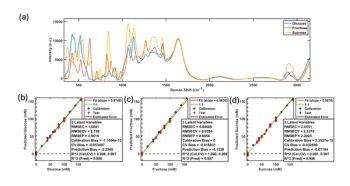
This column shows that a Raman plate reader paired with partial least squares regression can simultaneously quantify glucose, fructose, sucrose, and ethanol in yeast fermentation samples, using turbidity-matched calibration standards to correct for yeast-induced turbidity, and offers a rapid, label-free, high-throughput method for tracking sugar consumption and ethanol production in strain screening, media optimization, and process development.