Application Notebook
Low concentration natural methanol exists in most alcoholic beverages and usually causes no immediate health threat.
Application Notebook
Low concentration natural methanol exists in most alcoholic beverages and usually causes no immediate health threat.
Application Notebook
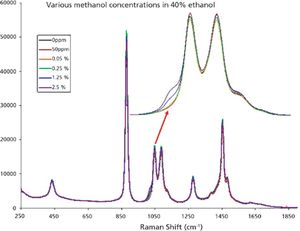
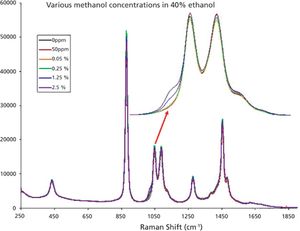
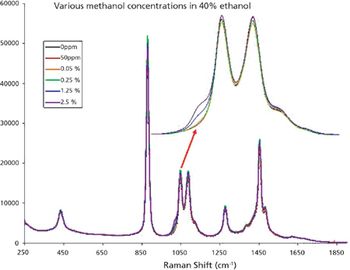
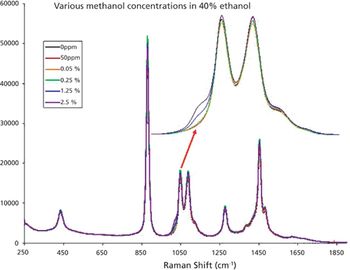
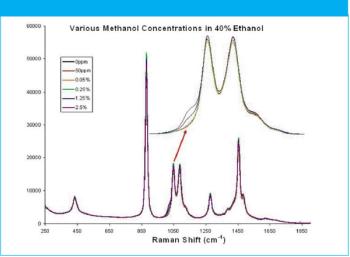
Low concentration natural methanol exists in most alcoholic beverages and usually causes no immediate health threat. Nevertheless, it is possible to have natural occurring methanol in beverages with concentration as high as 18 g/L of ethanol; or equivalent to 0.72% methanol in 40% ethanol, in alcohol (1). Current EU regulation limits naturally occurring methanol to below 10 g/L of ethanol; or equivalent to 0.4% methanol in 40% ethanol.
Application Notebook
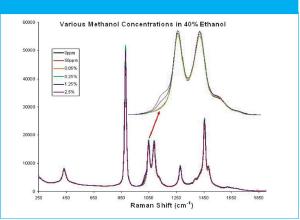
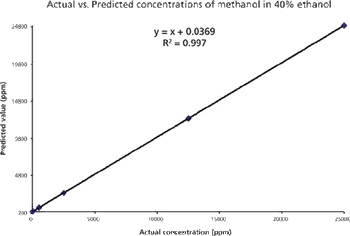
Low concentration natural methanol exists in most alcoholic beverages and usually causes no immediate health threat. Nevertheless, it is possible to have natural occurring methanol in beverages with concentration as high as 18 grams per liter of ethanol; or equivalent to 0.72% methanol in 40% ethanol, in alcohol (1). Current EU regulation limits naturally occurring methanol to below 10 grams per liter of ethanol; or equivalent to 0.4% methanol in 40% ethanol.
Application Notebook
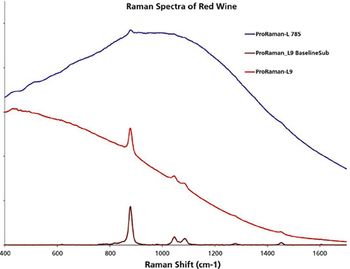
In recent years, the spectroscopy community has observed rapid development of Raman instrumentation and its usefulness in a variety of applications. Routine Raman analysis with 785 nm excitation has served well for the great majority of industrial applications and has become the most favored instrument configuration.
Spectroscopy
Low concentration natural methanol exists in most alcoholic beverages and usually causes no immediate health threat.

Application Notebook
Low concentration natural methanol exists in most alcoholic beverages and usually causes no immediate health threat.
February 11th 2011