
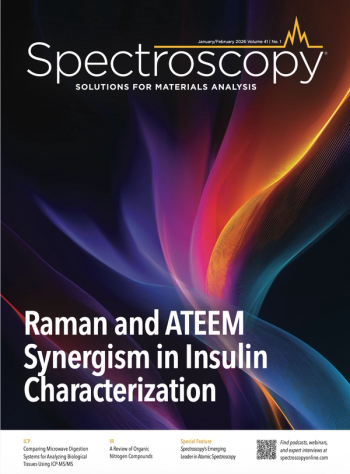
Click here to access the Spectroscopy 2026 January/February Europe PDF in an interactive format.
Click here to access the Spectroscopy 2026 January/February Europe PDF in an interactive format.
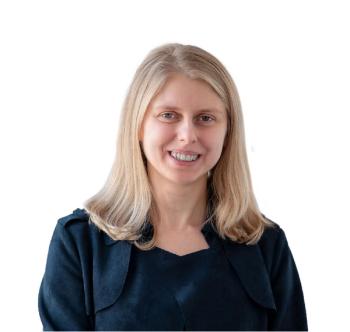
This year’s Emerging Leader in Atomic Spectroscopy Award recipient is Sarah Theiner, whose research is focused on the application of atomic spectroscopy techniques—laser ablation inductively coupled plasma–mass spectrometry (LA-ICP-MS) and single-cell ICP-MS—to expand these analytical techniques as tools for biological and clinical imaging and drug-distribution studies.
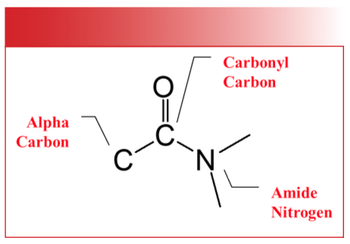
In our ongoing review of infrared spectra, we will study organic nitrogen containing compounds including amides and amines. Amides contain both nitrogen and a C=O group and are found in proteins and polymers. Amines contain carbon, nitrogen, and hydrogen, and are ubiquitous in medicines. As always, concepts will be illustrated with reference spectra.
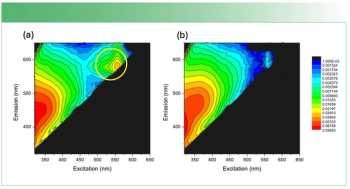
This column will show Raman results and ATEEM fluorescence whose correlations indicate that important information is available non-destructively.

Pittcon, one of the foremost laboratory science conferences, makes its Texas debut at San Antonio’s Henry B. González Event Center from March 7 to 11. The conference’s technical program of over 1100 sessions provides analytical scientists with direct access to the latest research and developments from an international assembly of top scientists and research pioneers.
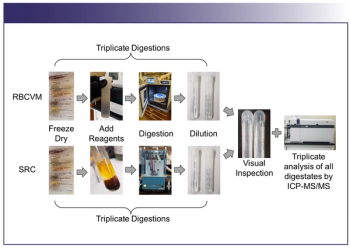
The primary goal of this study was to evaluate two microwave digestion systems for the acid decomposition of biological tissues: (1) a single reaction chamber (SRC) system and (2) a rotor-based, closed vessel microwave (RBCVM) system.
In 2025, the vibrational-spectroscopy community saw a convergence of deep learning, advanced simulation, and portable instrumentation that materially changed how spectra are interpreted and applied.

Fourier transform infrared (FT-IR) spectroscopy is a versatile, non-destructive analytical tool used to characterize molecular structures, monitor chemical reactions, and quantify analytes in diverse materials. This mini-tutorial reviews fundamental principles, key operational modes, and practical examples across environmental, biomedical, and industrial applications. Readers will review and learn how to optimize FT-IR methods, interpret spectra, and avoid common pitfalls in data collection and processing.

A recent study presented a new AI model that can be used to improve patient outcomes for breast cancer.
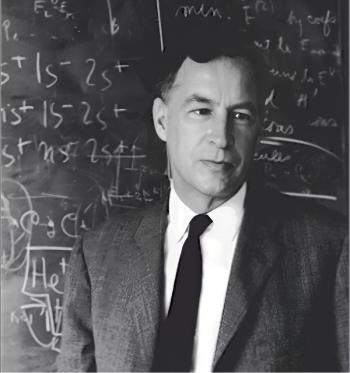
This Icons of Spectroscopy Series article features E. Bright Wilson, a pioneer of chemical physics. Wilson’s contributions to infrared, Raman, and microwave spectroscopy provided the theoretical and practical foundation for analyzing molecular structure and dynamics. As a revered professor at Harvard and coauthor of landmark texts, he mentored nearly 150 students and researchers, leaving a lasting legacy of scientific excellence and integrity.