The combination of fast, modular spectrometers from Ocean Optics, with powerful chemometrics tools creates new opportunities for rapid, on-site testing of foods and other samples. From quick and inexpensive measurements in complex situations, to sample identification rivaling expert abilities or online quality control – the possibilities are endless.
The Infrared and Raman Discussion Group’s 238th meeting on December 21 will feature the IRDG-Coblentz Lecture, two award presentations, and talks spanning clinical Raman, SERS, and ultrafast spectroscopy.
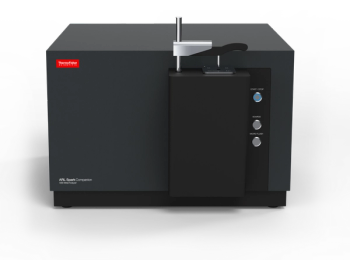
According to Thermo Fisher, the ARL Spark Companion pairs a multi-optics complementary metal-oxide-semiconductor (CMOS) detector with a compact spark source, aiming to move alloy verification out of external laboratories and closer to production.
Organized by CPACT, the April 27 to 29 meeting at the Marriott Pittsburgh City Center will bring together scientists, engineers, and vendors across the process industries, with keynotes on PAT, Raman, and NIR applications and an abstract deadline of December 7, 2026.
Garth Simpson of Purdue University outlines plans to survey more ordered molecular assemblies and to apply interface-specific chiral spectroscopy to enzyme reactors, solid-phase synthesis, spin-selective reactions, and, ultimately, a new analytical method.
In this Eastern Analytical Symposium (EAS) interview, Garth Simpson of Purdue University explains how a simple geometric effect at interfaces produced a 4.5-degree rotation in fluorescence emission from a naproxen monolayer.
Spectroscopy's editors gather 143 evergreen articles from 2026, including tutorials, terminology guides, technique reviews, application surveys, peer-reviewed research and the magazine's long-running columns, and organize them by subject so readers can build lasting knowledge one topic at a time.
A Q&A interview from SciX explored a porous-particle Raman platform became an alternative to SERS, and why AI could unlock biochemical meaning in vibrational spectra.
X-ray analytical techniques, spanning X-ray fluorescence (XRF), X-ray diffraction (XRD), and X-ray photoelectron spectroscopy (XPS), are becoming faster, more portable, and more energy-efficient, with microbeam XRF spot sizes once exclusive to synchrotrons now available on laboratory benchtops.