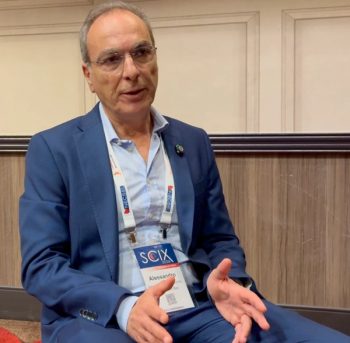
At SciX, Alessandro De Giacomo explains how a 35-member international jury chose three papers: one on correct ICCD use and two applications using LIBS and LA-ICP-MS. He also explains what the selections say about the field.
Hunter Andrews, an R&D Staff Scientist at Oak Ridge National Laboratory, discusses the work that he does in his laboratory.
"Inside the Laboratory" is a joint series with LCGC and Spectroscopy, profiling analytical scientists and their research groups at universities all over the world. This series spotlights the current chromatographic and spectroscopic research their groups are conducting, and the importance of their research in analytical chemistry and specific industries. In this edition of “Inside the Laboratory,” Hunter Andrews, an R&D Staff Scientist in the Isotope Applications Research Group within the Radioisotopes Science and Technology Division at Oak Ridge National Laboratory (ORNL), discusses the work that he conducts at ORNL, the largest science and energy laboratory operating under the U.S. Department of Energy (1,2).
This interview was conducted as part of our coverage of the Winter Conference on Plasma Spectrochemistry, which is taking place from January 9–17th in Tucson, Arizona (3).
Spectroscopy: Can you talk about your main research focus at Oak Ridge National Laboratory? What research projects is your group currently working on?
Hunter Andrews: I joined ORNL five years ago. When I first joined, I had a lot of experience with laser-induced breakdown spectroscopy (LIBS), but not a lot with the other spectroscopies. The main project that I was starting out on was this molten salt reactor (MSR) off-gas monitoring with LIBS, and I quickly became really fascinated with using spectroscopy for real-time monitoring and being able to either shine a light or shoot a laser, and within microseconds get this response and quantification on the screen in front of us. It was really fascinating to me, and so we basically expanded that a lot to other project scopes. Beyond just LIBS, we're doing this with absorbance spectroscopy for a lot of liquid applications. We're looking at Raman for molecular signatures, and we're doing it to a variety of different application spaces. There are molten salts, there's other nuclear applications, like radioisotope production, and even fusion reactors. Some of their designs will have a molten salt blanket and so monitoring that blanket for impurities and stuff like that is really important.
And then there's other fuel cycle applications, so reprocessing used nuclear fuel, because a lot of the useful material is still in there. That's an ongoing research field of ours.
This video clip is the third part of our conversation with Andrews. To stay up to date on our coverage of the Winter Conference on Plasma Spectrochemistry, click