Diffuse Reflectance Infrared Fourier Transform Spectroscopy (DRIFTS) is one of the most powerful techniques for catalyst research and material analysis. To ensure you generate reliable, repeatable, and decision-ready data, you need to have the right systems, practices, and training in place. This interactive checklist tool will help you analyze your current set up to troubleshoot or improve your set up.
Near-infrared (NIR) spectroscopy, built on the weak overtone and combination-band absorptions first exploited commercially in the 1970s, is now being reshaped by chip-scale MEMS sensors, rapid field calibration methods, and increasingly capable chemometric and machine-learning models.
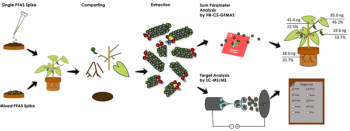
This Atomic Perspectives column explains how high-resolution continuum source graphite furnace molecular absorption spectrometry (HR-CS-GFMAS) quantifies extractable organic fluorine (EOF) as a PFAS sum parameter, complementing LC-MS/MS target analysis, with applications to German river sediments, bean plants, and fluorinated polymer sealing materials.
At SciX, Marc Porter explains how a Thanksgiving batting lesson led him to compare a bat meeting a ball to light scattering off a molecule, and how his group is using simulations to test whether the analogy holds.
Alessandro De Giacomo argues that grounding students in scientific fundamentals, rather than rushing them toward applications, is what makes breakthrough ideas possible.
In this SciX interview segment, Siddhartha Das explains how his group’s simulations revealed a nanochannel scenario that produces energy and boosts flow at the same time. This overturns the classical electroviscous trade-off without breaking the laws of thermodynamics.
At SciX, Juergen Popp explains why a new infection test must fit hospital workflows, outperform the gold standard, and cost about a euro or less per test. He also describes a host-response test that could change how emergency departments treat suspected sepsis.
Jay Kitt of the University of Utah explains that his group’s platform for quantitative Raman measurements inside chromatographic particles didn’t come from a search for signal enhancement. It grew out of a decade of chromatography and biochemistry research.