News|Videos|October 19, 2026

Stepping Up to the Plate: A Baseball Analogy for Raman Scattering

At SciX, Marc Porter explains how a Thanksgiving batting lesson led him to compare a bat meeting a ball to light scattering off a molecule, and how his group is using simulations to test whether the analogy holds.

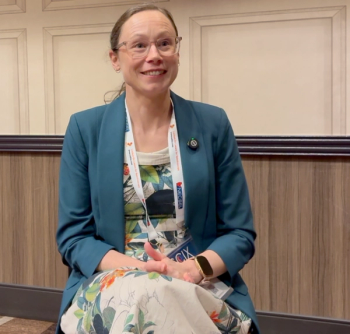
During an interview at SciX, Marc Porter, a Distinguished Professor Emeritus in Chemistry and Chemical Engineering at the University of Utah, shared how a family Thanksgiving in Ohio a few years ago sparked an unconventional, baseball-based way of explaining Raman scattering. His brother, a former college baseball player and coach, was teaching his grandchildren how to hit. He was also talking about how modern video analysis lets coaches study where the ball meets the bat, the size and smoothness of the bat, and the resulting trajectories toward right or left field.

Listening to that conversation, Porter recognized a parallel to Stokes and anti-Stokes scattering. Depending on whether a batter hits right- or left-handed, the ball tends to leave the bat toward different fields with different exit velocities, much as scattered photons can lose or gain energy. For example, he noted that left-handed hitters pull the ball and often generate higher exit velocities to right field than to left. In his team’s first, simple approach, the point where the ball strikes the bat determines its trajectory. Porter likens this interaction to a photon encountering the polarizable pi electron cloud of a molecule.

The analogy extends beyond scattering to other light–matter interactions. Porter explained that absorption is like a catch, while fluorescence is a catch followed by a throw. Raman scattering, he said, means you are lucky; against a 95-mile-per-hour fastball, most hitters end up hitting a line drive straight to the catcher.

Porter acknowledged that the comparison glosses over much of the underlying quantum mechanics and that progress has been slow, but he said the work is coming together. His group has now begun running simulations of a bat striking a baseball, and when differences in energetics are accounted for, the results start to resemble a Raman spectrum. Porter said he hopes to have the full story assembled and completed within the next few months, offering an accessible, familiar framework for explaining one of spectroscopy’s foundational phenomena.

Further Reading

(1) Porter, M.; Workman, J., Jr.; Wetzel, W. Taming Serum Interference: Marc Porter on Moving SERS Immunoassays Toward the Clinic. Spectroscopy Online, 2026. https://www.spectroscopyonline.com/view/taming-serum-interference-marc-porter-on-moving-sers-immunoassays-toward-the-clinic (accessed October 13, 2026).


Related to this article

2026 SciX Conference Summary ©   Bos Amico -chronicles-stock.adobe.com
SciX 2026, the annual conference presented by the Federation of Analytical Chemistry and Spectroscopy Societies (FACSS), ran October 4–9, 2026, at the Nugget Casino Resort in Sparks, Nevada. The program spanned atomic and molecular spectroscopy, mass spectrometry, chemometrics, and bioanalysis. This report follows the meeting day by day, from Monday's clinical Raman plenaries to Friday's closing talks, drawing on the online program and Spectroscopy coverage of award winners, highlighting efforts to move Raman, SERS, LIBS, and single-particle ICP-MS toward clinical, environmental, and field use.