Interpreting Near Infrared Excitation Raman Spectroscopy Data
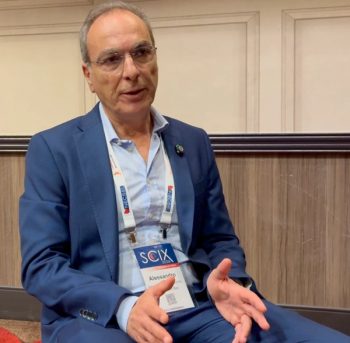
In this interview clip, Dmitry Kurouski, an Associate Professor of Biochemistry and Biophysics, and Biomedical Engineering at Texas A&M University, explains how his work is helping to develop a library of spectra and chemometric methods.
Dmitry Kurouski, who is an Associate Professor of Biochemistry and Biophysics, and Biomedical Engineering at Texas A&M University, recently delivered a talk at Pittcon 2026 that highlighted some of his team’s work in forensic analysis. In his talk, which took place on Sunday March 8th, was titled, “Near Infrared Excitation Raman Spectroscopic Analysis of Dyes Present on Fabric,” and it focuses on how Raman spectroscopy and near-infrared (NIR) spectroscopy can be used in tandem to analyze dyes in textiles and other fabrics.1
Kurouski’s team has worked on include Raman-based plant disease diagnostics, developing nano-infrared spectroscopy to characterize plant waxes and amyloids, and forensic analysis.2 At Pittcon, we asked him about the benefits of using near-infrared excitation Raman spectroscopy (NieRS) and how it can be used to achieve high dye identification accuracy even when fabrics and other samples are contaminated with bodily fluids.
In the fourth part of our conversation with Kurouski, we asked him about how forensic practitioners can find help in interpreting NIeRS results when analyzing real-world textile evidence exposed to environmental and biological contaminants. Kurouski discusses how his work is at the intersection of technology development, deployment, and education, particularly in the field of Raman spectroscopy.
Kurouski highlights the novelty of using normal Raman with infrared (IR) and near-infrared excitation to identify dyes on fabric, which has been a long-standing challenge. One way to resolve this challenge is to develop a library of spectra and chemometric methods, which Kurouski highlights is one of the things his team did. By making these methods and spectra publicly accessible for researchers worldwide to download and use, this knowledge could be disseminated to more researchers in various sectors exploring the practical applications of Raman spectroscopy in fields such as forensic science and art conservation.
Spectroscopy will be continuing to provide coverage of the Pittcon 2026 conference on an ongoing basis as we report back from San Antonio. You can stay up to date with our latest coverage of the Pittcon 2026 conference
References
- Pittcon, Near Infrared Excitation Raman Spectroscopic Analysis of Dyes Present on Fabric. Pittcon.org. Available at:
https://app.swapcard.com/event/pittcon-2026/planning/UGxhbm5pbmdfNDMxNzU3MA== (accessed 2026-03-16). - Texas A&M University, Dmitry Kurouski. TAMU.edu. Available at:
https://bcbp.tamu.edu/people/kurouski-dmitry/ (accessed 2026-03-16).