|Articles|January 1, 2005

Spectroscopy

  • Spectroscopy-01-01-2005
  • Volume 20
  • Issue 1

A New Approach to Near- and Mid-Infrared Process Analysis (PDF)

Encoded photometric technology has the ability to address the demands of modern process applications, including those of the PAT initiative.


Related to this article

Peter R. Griffiths (1942–2026): A Life Devoted to Infrared and Vibrational Spectroscopy
Peter R. Griffiths, a pioneering figure in Fourier transform infrared (FT-IR) spectroscopy who authored or coauthored more than 300 scientific papers and numerous books over five decades, died August 29, 2026, at age 84. This tribute traces his career from Oxford and Digilab through Ohio University and the University of Idaho, his landmark books and the Handbook of Vibrational Spectroscopy, and his many honors, including the 2023 Ellis R. Lippincott Award and 2024 Optica Fellowship.
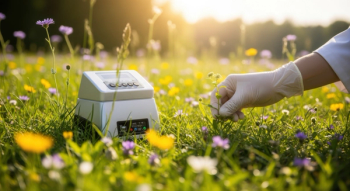
Scientist With Portable Spectrometer in Natural Field Setting ©  By Tika -chronicles-stock.adobe.com
The bulky bench-top NIR spectrometer is quietly being dismantled and rebuilt as a wafer-scale photonic chip, a self-calibrating algorithm, and a sensor small enough to ride in a shirt pocket. What once demanded a grating, a moving mirror, and a climate-controlled lab now fits inside a handheld module, a bioreactor probe, or a drone payload, and it increasingly figures out what it is looking at on its own.
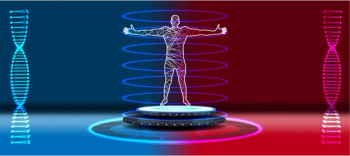
Human body wireframe on glowing platform undergoing futuristic body scan. © sergray(noAIelemens) -chronicles-stock.adobe.com
Jurgen Popp, Thomas Mayerhofer, and colleagues at Leibniz IPHT and Friedrich Schiller University Jena introduce the Personalized Optical Digital Twin (PODT), a Photonics21 contribution to Europe's Virtual Human Twin ecosystem that connects molecular photonics—Raman blood analysis, coherent Raman tissue imaging, and multimodal endomicroscopy—with longitudinal physiology and clinical data. Drawing on the published multicenter INTELLIGENCE trials, the authors argue that technical feasibility and clinical utility must be evaluated separately as the field moves toward Europe's FP10 research agenda.