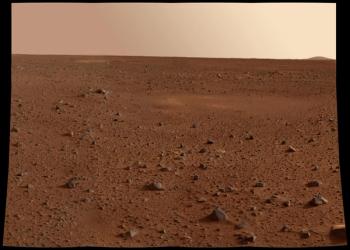
The Canadian Space Agency contract funds refinement and prototype testing of a laser-based cavity spectrometer intended to monitor trace methane continuously at the Martian surface.
The advanced high-performance, fully integrated, 4-port readout, thermoelectrically cooled Quad-RO: 4096 camera with electronically balanced quadrants, dual speed readout, on board memory to guarantee images w/o losses, capability to read images at 4-port or single port and industry standard firewire (IEEE 1394a) interface is designed for indirect imaging of X-rays or other Lambertian sources. The ability to exchange phosphors in the field using a unique design, with fiberoptic extending outside the vacuum, delivers flexibility to optimize system performance at the desired x-ray energy. When used with the software-selectable dual speed operation and gains, the system can be optimized for any demanding applications. The GdOS:Tb phosphor screens are available for 8, 12 and 17 keV at an emission wavelength of 550 nm. Contact your area sales specialist or the factory for CsI:Tl phosphor screens. Key Features and Benefits Electronically balanced quadrants to deliver extremely uniform raw image Industry standard firewire (IEEE 1394a) interface Two readout speeds / port Four port and single port readout options On board memory to guarantee loss free images Unique mechanical design with fiberoptic extended outside vacuum allows system performance optimization with custom phosphor screens Image files compatible with FIT2D software from ESRF Thermoelectrically Peltier cooling for vibration free operation
Princeton Instruments
Quad-RO
The advanced high-performance, fully integrated, 4-port readout, thermoelectrically cooled Quad-RO: 4096 camera with electronically balanced quadrants, dual speed readout, on board memory to guarantee images w/o losses, capability to read images at 4-port or single port and industry standard firewire (IEEE 1394a) interface is designed for indirect imaging of X-rays or other Lambertian sources. The ability to exchange phosphors in the field using a unique design, with fiberoptic extending outside the vacuum, delivers flexibility to optimize system performance at the desired x-ray energy. When used with the software-selectable dual speed operation and gains, the system can be optimized for any demanding applications. The GdOS:Tb phosphor screens are available for 8, 12 and 17 keV at an emission wavelength of 550 nm. Contact your area sales specialist or the factory for CsI:Tl phosphor screens.
Key Features and Benefits