


Feature|Videos|July 9, 2025
Advanced Analytical Techniques to Monitor Water Purity
Panelists discuss cutting-edge advances in monitoring ultra-pure water (UPW) purity, from ICP-MS to online pre-concentration, and the growing push for sub-ppt-level contaminant detection.
Advertisement
Episodes in this series







As chip sizes shrink, water contamination limits must drop to unprecedented levels. This episode reviews current instrument capabilities, future standards, and the need for dedicated online pre-concentration to support real-time purity assurance.
Key discussion topics include:
- Current and future detection limits for critical elements.
- The importance of stable and ultra-pure water 24/7.
- New online pre-concentration systems to enable sub-ppt analysis.
Advertisement
Related to this article

X-ray analytical techniques, spanning X-ray fluorescence (XRF), X-ray diffraction (XRD), and X-ray photoelectron spectroscopy (XPS), are becoming faster, more portable, and more energy-efficient, with microbeam XRF spot sizes once exclusive to synchrotrons now available on laboratory benchtops.

Jürgen Popp, winner of this year’s Ellis R. Lippincott Award, discusses the regulatory, cost, and workflow hurdles of moving Raman spectroscopy into hospitals.

A recent conversation with Kevin Wilkinson, a professor of environmental chemistry at the Université de Montréal, sheds light on why no single signature can separate engineered nanoparticles from natural ones.

Top articles include the publication of a new terminology guide focused on data processing, machine learning, artificial intelligence (AI), and chemometrics.
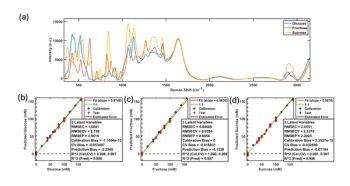
This column shows that a Raman plate reader paired with partial least squares regression can simultaneously quantify glucose, fructose, sucrose, and ethanol in yeast fermentation samples, using turbidity-matched calibration standards to correct for yeast-induced turbidity, and offers a rapid, label-free, high-throughput method for tracking sugar consumption and ethanol production in strain screening, media optimization, and process development.
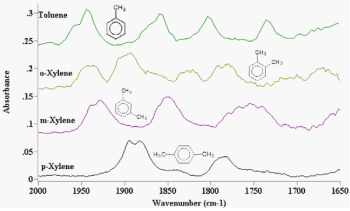
This column, the second installment on highly substituted benzene rings, shows that tri- and tetra-substituted substitution patterns can be distinguished by whether the ring bending peak is present and by the position of the in-phase aryl C-H wagging peak, which shifts according to how many adjacent hydrogens the ring carries.

How do ions and water interact at the atomic level in nanochannels grafted with polymer brushes using all-atom molecular dynamics simulations? Siddhartha Das of the University of Maryland and his team are working on answering this question.

Mammograms can find breast microcalcifications but can’t tell whether they are likely benign or malignant.
Advertisement
Advertisement
Trending on Spectroscopy Online
1
The Latest in Surgical Raman Probes, Sepsis Diagnostics, and the Personalized Optical Twin
2
Monitoring Sugar Consumption and Ethanol Production During Yeast Fermentation Using a Raman Plate Reader and Multivariate Analysis
3
Advances in Spectroscopy for Pharma and Biopharmaceutical Analysis Symposium
4
Highly Substituted Benzene Rings—The Rest of the Story II: Spectra
5