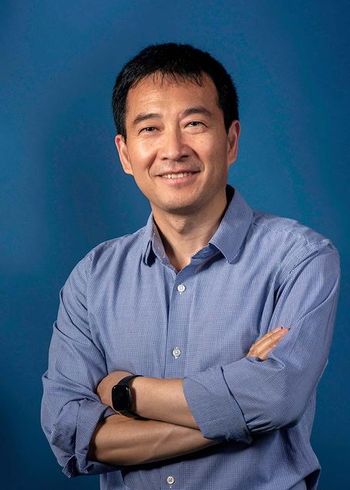
Christy Haynes, the Elmore H. Northey Professor of Chemistry at the University of Minnesota (St. Paul and Minneapolis, Minnesota), will receive the 2018 RSC Theophilus Redwood Award at SciX 2019 at the Palm Springs Convention Center in California. Because Haynes was on sabbatical in Europe in 2018 during the time when the award would have been presented, she will receive her award this year at SciX.
Haynes earned her PhD in chemistry at Northwestern University (Evanston, Illinois) under the direction of Richard P. Van Duyne. Her research group is dedicated to applying analytical and nanomaterials chemistry in the context of biomedicine, ecology, and toxicology. More specifically, her areas of research interest include the development of the use of new tools to assess chronic or acute exposure of nanoscale and molecular toxicants at the cellular level; the development of sensing systems for use in complex matrices; and the application of bioanalytical tools in biomedical systems.
Haynes has received many honors, including being recognized as an Alfred P Sloan Fellow, a Searle Scholar, A Dreyfus Teacher-Scholar, a National Institutes of Health “New Innovator,” and a 2018 Guggenheim Fellow. She has participated in more than 150 peer-reviewed publications and is an advocate of diversity in science, technology, engineering, and math (STEM) fields and of dialogue between scientists and the public.
The Theophilus Redwood Award is given to a leading analytical scientist who is also an outstanding communicator.
Haynes will also receive the 2018 Coblentz Society created the Craver Award this year at SciX.
The Coblentz Society created the Craver Award in 2006 to recognize the efforts of young professional spectroscopists who have made significant contributions in applied analytical vibrational spectroscopy. The award is named for Clara D. Craver in recognition of her pioneering efforts in promoting the practice of infrared vibrational spectroscopy, and her many years of service to the Coblentz Society.
To read more about Haynes and her work with screening affinity agents for use with surface-enhanced Raman scattering, click here