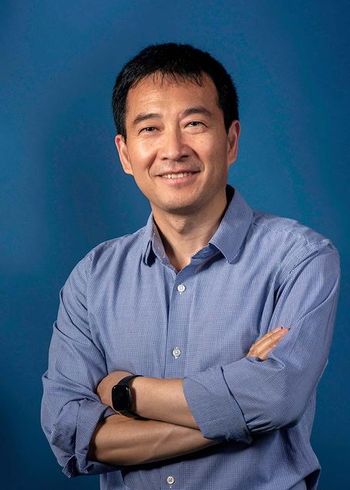
The 2022 Craver Award will be presented to Wei Min at SciX, taking place October 2–7 at the Northern Kentucky Convention Center in Greater Cincinnati. Min is a professor of chemistry at Columbia University. He also is affiliated with the Department of Biomedical Engineering, the Kavli Institute for Brain Science, and the NeuroTechnology Center, all at Columbia University.
Min has made important contributions to the development of stimulated Raman scattering (SRS) microscopy and used it to open up a broad range of applications. He has co-invented modern SRS microscopy and pushed its sensitivity down to the single-molecule level through stimulated Raman-excited fluorescence (SREF) spectroscopy. His team also has designed and synthesized Raman-active probes exhibiting rainbow-like spectral “colors”. In addition, his group has opened up applications including bio-orthogonal chemical imaging of small biomolecules (such as lipids, amino acids, glucose, and drugs), metabolic activity imaging in animals, and super-multiplexed vibrational imaging.
The Craver Award is conferred by the Coblentz Society, which created the award to recognize the efforts of young professional spectroscopists who have made significant contributions in applied analytical vibrational spectroscopy. The Coblentz Society was named after Dr. William Coblentz (1873–1962), who devoted most of his life to investigating the infrared spectra of “pure” compounds. The society was founded more than 65 years ago with the purpose of fostering the understanding and application of vibrational spectroscopy.