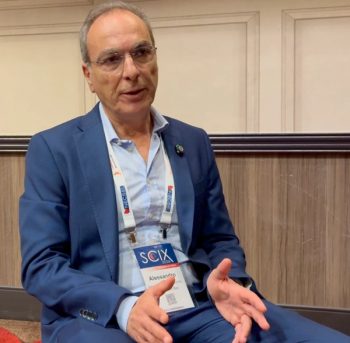
At SciX, Alessandro De Giacomo explains how a 35-member international jury chose three papers: one on correct ICCD use and two applications using LIBS and LA-ICP-MS. He also explains what the selections say about the field.
Hunter Andrews, an R&D Staff Scientist at Oak Ridge National Laboratory, discusses the key role that laser-induced breakdown spectroscopy (LIBS) plays in his research.
Laser-induced breakdown spectroscopy (LIBS) is a rapid, in situ technique that has a fast measurement time for single-spot analysis (1). LIBS is also characterized by its broad elemental coverage, and it is capable of analyzing both lighter elements, such as lithium and carbon, as well as heavy metallic elements (1).
Because of the advantages that LIBS offers, it is often used when elemental analysis is required. Recently, we sat down with Hunter Andrews, an R&D Staff Scientist at Oak Ridge National Laboratory, to talk about the value LIBS offers for his research (2).
This interview was conducted as part of our coverage of the Winter Conference on Plasma Spectrochemistry, which is taking place from January 9–17th in Tucson, Arizona (3).
Spectroscopy: Laser-induced breakdown spectroscopy (LIBS) plays a key role in your research because of its rapid elemental analysis across all sample forms. What advantages does LIBS offer over other optical spectroscopy methods, and what challenges remain in optimizing its performance for demanding environments?
Hunter Andrews: I think all techniques have their pros and cons, right? I think the best answer for every problem is a combination of things, but the main advantages of LIBS are versatility and what it can see. Using LIBS, you can see pretty much everything in the periodic table, all the way from your light elements to your heavy elements, and you can do so very quickly. In terms of sensitivity, you have a lot of versatility too. You can design a system with a pretty moderate price tag that can, you know, give you sensitivity limits from 10s to hundreds of ppm, depending on the element.
But if your situation needs higher sensitivity, you can change your system and modify it, do enhancement techniques like double pulse or hyphenated LIBS techniques, or even swap out your spectrometer for something that's a little bit more fine-tuned for what you're looking for. And so, LIBS gives you a lot of customization around what you're going after, and I think that makes it a really great technique for matching it to the question asked.
That versatility also gives you kind of the freedom to design it for whatever demanding application that you're being asked to design it for. In terms of challenges, I think LIBS has been around for a long time, and I think there's still a lot of improvements to be made. The main challenge for LIBS comes in the form of matrix effects. For example, you can make a calibration for iron and make it really well and show great sensitivity for it, but the second you throw another element in the mix, your emission profiles are going to change, your plasma characteristics are going to change, and that calibration might not be valid anymore. Sometimes, it will be. But when you think about traditional analytical techniques, it's easy to build a calibration and apply it and be able to just do that repeatedly, and that's usually because they're being done offline. When things are being done online, you don't have the ability to matrix match things. So, I think one of the biggest research areas that we still need to dive into, and it's not a small feat by any means.
This video clip is the fourth part of our conversation with Andrews. To stay up to date on our coverage of the Winter Conference on Plasma Spectrochemistry, click