
There are multiple circumstances where characterization of a collection of particles has value to analysts. In some environments, materials are plagued by particulate contamination that impacts product quality.

Fran Adar is the Principal Raman Applications Scientist for Horiba Scientific in Edison, New Jersey.

There are multiple circumstances where characterization of a collection of particles has value to analysts. In some environments, materials are plagued by particulate contamination that impacts product quality.

Metal oxides often occur in crystals where there are no molecular units. Here, we provide an introduction to the concepts that need to be understood when analyzing metal oxides in materials such as paint, ceramic pigments, corrosion films, catalysts, and minerals.

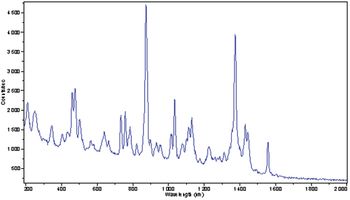
Results of tablet matching measurements and characterization of packaging are presented.

The physics that determine how gratings and spectrographs work are summarized in simple terms for new users of Raman equipment.

The presence of electronic transitions in the visible part of the spectrum can provide enormous enhancement of Raman signals.

Here, real spectra illustrate how to be your own critic when evaluating band-fitted spectra.

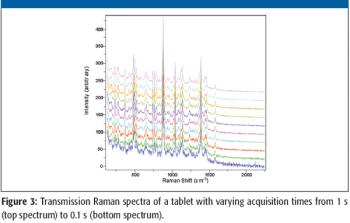
The motivation for the development of an instrument for transmission Raman measurements is described. The basic instrumentation and the first results from a commercial system are provided. Transmission Raman spectroscopy (TRS) performance is compared to and contrasted with that of a confocal Raman microscope.

Columnist Fran Adar discusses applications for Raman and FT-IR spectroscopy.

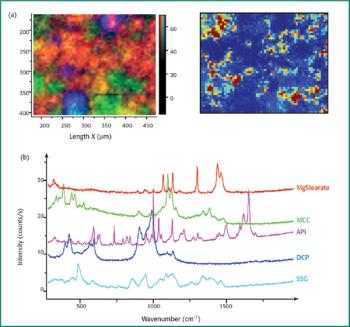
Manufacturing control of pharmaceutical solids requires routine measurement of content uniformity. Because of the high information content in Raman spectra, it has been considered a candidate technology for making these measurements.

In this article, columnist Fran Adar will review the important features of the Raman spectra of these materials and indicate why the extracted information is important for material development and engineering.

Compounds of magnesium and calcium are common components of pharmaceutical formulations. Spectroscopic imaging can provide a complete understanding of a formulation. This paper compares two spectral imaging techniques — energy dispersive X-ray fluorescence (EDXRF) microscopy and Raman microscopy.

The authors discuss how the Raman microscope is being used successfully to characterize pharmaceuticals, analyze disease states, and to characterize semiconductors and nanotechnologies.