Articles by PerkinElmer, Inc.

Inductively coupled plasma optical emission spectrometry (ICP-OES) is the preferred technique for inorganic contaminant analysis of biodiesel, and PerkinElmer offers two technologies to support it. The Avio 220 Max and Avio 550 Max, combined with PerkinElmer's expertise, can help labs achieve accurate feedstock analysis demanded by today's market.
Demonstrating the ability of PerkinElmer’s Spectrum 3 to measure in multiple regions of the infrared spectrum to provide an all-in-one infrared solution for a variety of markets
Join us for a webcast presentation in which Dr. Ryan Smith, a Senior Field Applications Scientist at Perkin Elmer, explains principles of infrared microscopy. This presentation will include several practical examples which highlight the insights provided by this technology when testing challenging and unknown samples.
Live: Thursday, Feb. 27, 2020 at 11am EST | 8am PST | 4pm GMT | 5pm CET
On demand available after airing until Feb. 27, 2021
Register free
This application note shows the ability of PerkinElmer's Avio® 500 ICP-OES to achieve RSDs < 0.1% for matrix elements in simulated battery materials, thanks to its ability to perform true simultaneous measurements.
This work illustrates the ability of PerkinElmer’s Avio® 200 hybrid scanning ICP-OES to accurately and reliably measure impurities in aluminum at levels specified in the London Metal Exchange.
Please fill in your information below to access this poster
Explore how to determine amounts of different components in a mixture based on their relative thermal stability, by better separation, using a Thermogravimetric Analyzer.
Learn about temperature accuracy and obtaining reliable thermogravimetric data using improved temperature calibration and control algorithms in a Thermogravimetric Analyzer with accurate and responsive temperature control and read-out.
Learn how to achieve reliable accuracy, reduced test time, and reproducibility, when using thermogravimetry to quantify the components of automotive rubber products, namely oil, polymer, carbon and inorganic filler.
Learn how to measure properties of Gold Nanoparticles that have unique optical, electronic, and thermal properties and used in a wide range of applications including diagnostics assays, microscopy and electronics.
Learn how the spectral characterization of Enhanced Spectral Reflector (ESR) films is an important step in developing new novel applications for these unique materials. From enhanced skylights to brighter displays ESR films play an important role.
All optical coating that receive light from, or direct light into, non-normal angles-it is vital to characterize the wavelength-, angle-, and polarization-resolved reflectance and transmittance. Learn how to measure new materials that have emerged to meet new applications.
Learn about the potential of molecular spectroscopy techniques launched for screening a number of whisky authenticity problems and recommended suitable miniaturization approaches for the fight against spirit fraud.
Coupling, or hyphenating, two instruments can uncover results and insights not possible with individual techniques. Explore how the power of your analysis, becomes greater than the sum of its parts.
Global exporting of Olive Oil is continuously growing, which poses a series of challenges by the worry of intential adulteration for financial profit or unintentional environmental contaminant. Explore the techniques for identifying contaminants.
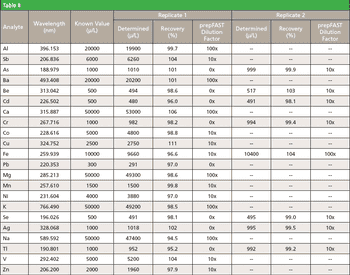
This application brief will give a summary of a more thorough application note (1), which describes the analytical capabilities of Optima? 8300 ICP-OES utilizing low flow conditions, coupled to the prepFAST? in-line, auto-dilution/calibration sample delivery system to determine a suite of environmentally-significant elements in potable and waste waters according to US EPA Method 200.7.
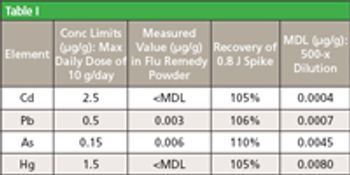
This application brief will give an overview of a published article (1) that describes the analytical capabilities of the NexION? 300X ICP-MS coupled to the prepFAST? in-line, auto-dilution/auto-calibration sample delivery system to determine a suite of toxicologically-relevant elements in a group of four pharmaceutical products using the new USP Chapters <232> and <233>, which have replaced the 100-year old sulfide-based method described in Chapter <231>.

