Ryan Brennan

Articles by Ryan Brennan

Nebulizer selection is a critical but often overlooked aspect of inductively coupled plasma–optical emission spectroscopy (ICP-OES) analyses. There are many different nebulizers available for ICP-OES, and choosing the optimal one can be confusing and difficult. To achieve peak performance from your ICP, it is essential to choose the proper nebulizer based on your sample types in addition to any necessary accessories to maintain long-term performance. In this study, we compare the performance of Glass Expansion’s most popular concentric nebulizer designs for ICP-OES applications as well as a parallel-path nebulizer from another vendor, providing a complete selection guide based on performance and design.
Glass Expansion designed and patented the D-Torch, a revolutionary, demountable torch. The D-Torch uses high-precision engineering to provide the benefits of a demountable torch, such as lower running costs, chemical inertness, and configurable injector geometry, without compromising usability, performance, or durability. In this report, we discuss the effects of harsh matrices on torches, as well as the features, benefits, and improvements in analysis achieved with the D-Torch.

Spectroscopy3_i1.jpg

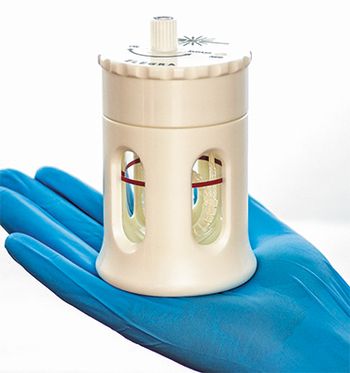
The elegant design of the Elegra results in a very compact accessory (Figure 1), making it easy to fit every ICP model without overcrowding the sample compartment. The Elegra utilizes highly efficient membrane technology to add moisture to the argon as it flows through the inert metal-free construction. The device runs at atmospheric pressure and does not require heating or electric power. The Elegra is also configured with a bypass switch so that the operator can turn humidification on and off without connecting or disconnecting any tubing. For easy installation on any ICP instrument and nebulizer, each Elegra Kit is packaged with customized gas connectors.

Latest Updated Articles