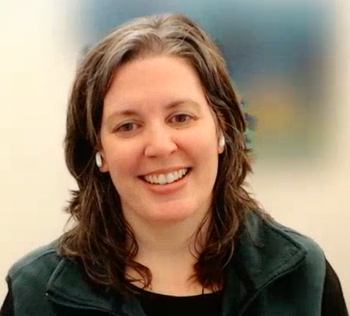
In this "Pathways in Spectroscopy" clip, Kevin Wilkinson explains why adaptability, critical evaluation of instruments, and data analysis skills matter more for graduate students than mastering any single technique.
Garth Simpson of Purdue University outlines plans to survey more ordered molecular assemblies and to apply interface-specific chiral spectroscopy to enzyme reactors, solid-phase synthesis, spin-selective reactions, and, ultimately, a new analytical method.
In this interview clip, Kristin L. Wustholz of William & Mary explains how her group judges the fidelity of its blinking-based classifications, why real artworks will call for classification libraries, and where the method fits alongside SERS.
Garth Simpson of Purdue University explains how patterned photobleaching and spatial Fourier transforms can turn a single-point measurement into a diffusion coefficient at every pixel in the field of view.
In the below Eastern Analytical Symposium (EAS) interview, Kristin Wustholz of the College of William & Mary explains how machine learning applied to fluorescence blinking can identify dyes from cultural heritage objects without relying on SERS or spectral data.
Garth Simpson of Purdue University previews an upcoming chirality session at the Eastern Analytical Symposium and explains why the meeting’s blend of academic and industry researchers produces the most impactful science.
In this Eastern Analytical Symposium (EAS) interview, Garth Simpson of Purdue University explains how a simple geometric effect at interfaces produced a 4.5-degree rotation in fluorescence emission from a naproxen monolayer.
A Q&A interview from SciX explored a porous-particle Raman platform became an alternative to SERS, and why AI could unlock biochemical meaning in vibrational spectra.