

Spectroscopy
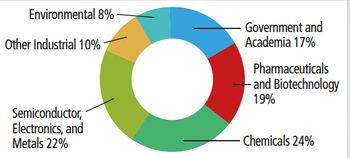
The advancements of battery and computing technologies have enabled analytical instruments to have smaller form factors that take them beyond portableand into the realm of being handheld.
Spectroscopy
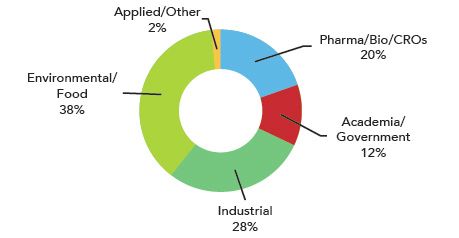
The advancements of battery and computing technologies have enabled analytical instruments to have smaller form factors that take them beyond portableand into the realm of being handheld.
Spectroscopy
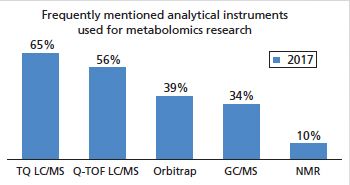
Metabolomics is one of the newer “omics” fields, and focuses on the characterization of the small molecule metabolites in biological systems. Metabolomics research has the potential to shed light on certain disease states, monitor patient response to treatment, and contribute to drug target discovery. Applications also span pharmaceutical development and neuroscience research.
Spectroscopy
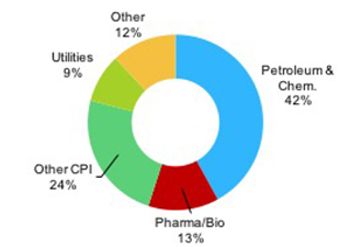
Measuring moisture at high or trace amounts in is an important parameter of many manufacturing processes including commercial food production, pharmaceutical, and chemical manufacturing or other industrialized fabrication setting.
Spectroscopy
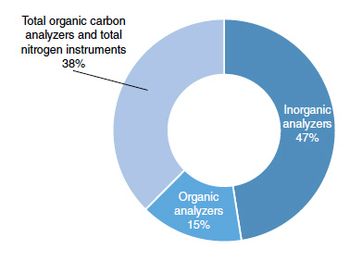
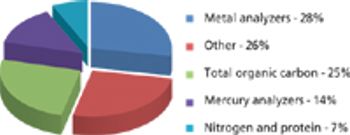
The market for elemental analyzers embodies three technology categories, consisting of inorganic analyzers, organic analyzers, and total organic carbon and total nitrogen (TOC–TN) instruments.
Spectroscopy
Nondispersive infrared photometers are relatively simple instruments used to detect gases.
Spectroscopy
Over the past decade, benchtop nuclear magnetic resonance instruments have been used in the petroleum and petrochemical industries for process control applications.
Spectroscopy
The use of photodiode-array (PDA) ultraviolet–visible (UV–vis) spectrophotometers is mainly adopted in industrial applications such as pharmaceutical and chemical production, coatings, or food and agriculture processing.
Spectroscopy
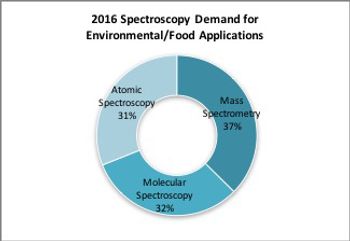
Although weakness in the metals and mining industry has challenged the market for spectroscopy instruments in 2016, the demand for environmental and food testing have been robust, forging growth for key technologies such as ICP and ICP-MS.
Spectroscopy
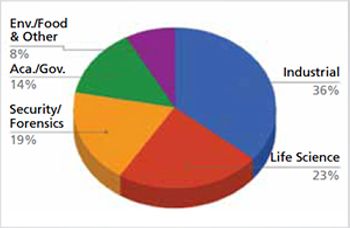
Raman spectroscopy is one of the fastest growing segments of the molecular spectroscopy techniques.
Spectroscopy
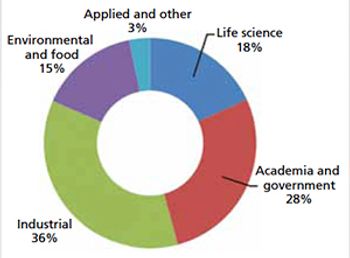
Spectroscopy has always been a key sector of the analytical and life science instrumentation industry because of the vastness of applications in just about every industrial sector.
Spectroscopy
While some atomic spectrometry systems can generally detect and quantify any element in the periodic table, other instruments are specifically designed to measure only one, or at most a few, elements of interest in a particular application.
Spectroscopy
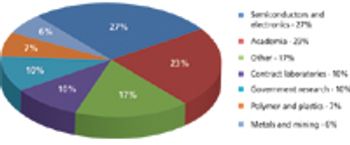
Although mass spectrometers are more commonly associated with life science applications, there are some mass spectrometry (MS) techniques that are specifically designed for surface science applications.
Spectroscopy
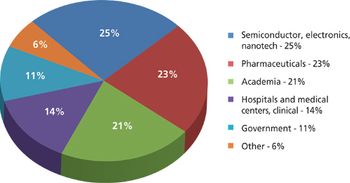
At the fringe of the infrared spectrum is the terahertz region, which until recently was not significantly utilized for spectroscopy.
Spectroscopy
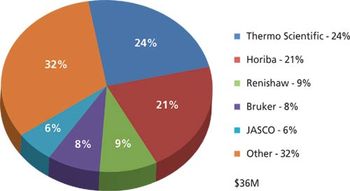
Raman spectroscopy has developed into a key analytical tool for the pharmaceutical industry.
Spectroscopy
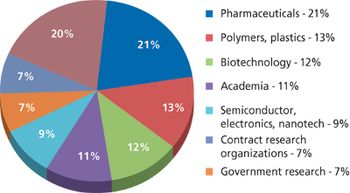
Infrared (IR) microscopy includes both conventional microscope systems and more advanced imaging systems, which are used in two ways.

Spectroscopy
Market Profile: Used IR and NIR Spectroscopy Instrumentation
Spectroscopy
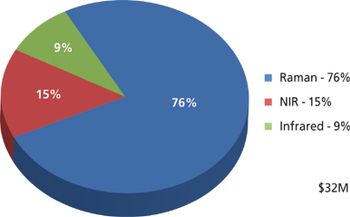
Portable molecular spectroscopy techniques used in the pharmaceutical and biopharmaceutical industries consist of Raman, infrared (IR), and near-infrared (NIR) spectroscopy.
Spectroscopy
Photodiode-array (PDA) UV–vis spectrophotometers offer an alternative to conventional scanning UV–vis instruments and potentially great benefits to a certain subset of end-users. Although it is not a high growth market, it should remain a sizeable market for many years to come.
Spectroscopy
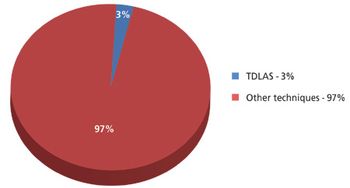
Market Profile: TDLAS Analyzers for Environmental Analysis
Spectroscopy
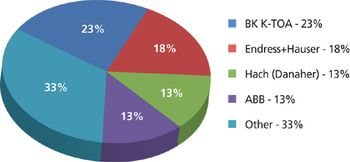
Market Profile: On-Line Ultraviolet 254-nm Water Analysis
Spectroscopy
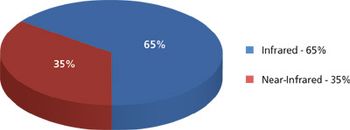
Market Profile: Laboratory and Portable IR and NIR in Environmental Analyses
Spectroscopy
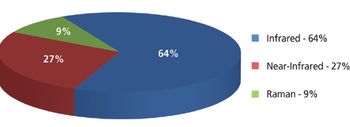
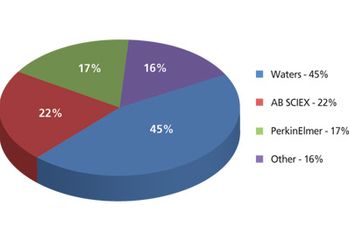
Triple-quadrupole liquid chromatography–mass spectrometry (LC–MS) is one of the most powerful quantitative analytical techniques available for clinical analyses, with recent improvements making it even more appealing to the clinical market. Waters has an extremely strong foothold in the market, but its competitors appear to be stepping up their efforts in the sector. Demand from the clinical industry is rapidly approaching 10% of the overall market for triple-quadrupole LC–MS.