News|Videos|October 30, 2026

Best of the Week: Inside the Revolution of Atomic Spectroscopy

Top articles include an examination of the current trends propelling atomic spectroscopy forward and post-conference coverage of the 2026 SciX show in Sparks, Nevada.

Atomic spectroscopy is currently going through a new revolution. Instead of new physics, these trends are emerging thanks to new instrumentation and software. Spectroscopy’s associate editorial director, Jerome Workman Jr., explored this revolution in an exclusive feature article published this week. We’ll talk about it. Also, Kevin Wilkinson of the Université de Montréal discussed next steps for his airborne metal pollution research.

This is the Best of the Week.

In his feature article, “Atoms Don’t Lie,” Workman explains how tools are reshaping a long-established field. Tandem inductively coupled plasma–mass spectrometry (ICP-MS/MS) now routinely removes spectral interferences, making trace analysis of elements like arsenic and selenium more defensible.1 Single-particle ICP-MS counts and sizes individual nanoparticles, while laser ablation ICP-MS maps trace elements at micrometer resolution. LIBS has left the laboratory entirely, analyzing rocks on Mars aboard Perseverance and, with machine learning (ML), helping classify tumor tissue.1 Portable instruments with embedded AI are also bringing laboratory-grade analysis into the field. Over the next five years, Workman expects autonomy, integration, and multiplexed single-particle and single-cell analysis to take center stage.

At SciX, Kevin Wilkinson shared how lead isotope analysis let his team track airborne particles six kilometers from their source. Next, he suggests sampling snow at greater distances.2 His advice for graduate students? Learn how to learn, question vendor claims, and pick up coding skills like Python to manage massive data sets.

Also at SciX, Amy Colleran of the University of Liverpool presented a simple SERS method for detecting volatile organic compounds. Her team bubbles gas into colloidal silver or gold nanoparticles while a portable Raman spectrometer records in real time.3 She sees uses in aroma, environmental, and breath analysis, though quantitation and selectivity still need work.3

Finally, our SciX recap highlights how spectroscopy is moving into clinical, industrial, and environmental practice, from AI-assisted Raman diagnostics to single-molecule vibrational imaging.4

References
  1. Workman, J., Jr. Atoms Don't Lie: Inside the Quiet Revolution Remaking Atomic Spectroscopy. Spectroscopy Online, 2026. https://www.spectroscopyonline.com/view/atoms-dont-lie-inside-the-quiet-revolution-remaking-atomic-spectroscopy (accessed October 28, 2026).
  2. Wilkinson, K.; Workman, J., Jr.; Wetzel, W. Learning How to Learn. Spectroscopy Online, 2026. https://www.spectroscopyonline.com/view/learning-how-to-learn (accessed October 28, 2026).
  3. Colleran, A. Detecting Volatile Compounds with Colloidal Nanoparticles and Portable Raman Spectroscopy. Spectroscopy Online, 2026. https://www.spectroscopyonline.com/view/detecting-volatile-compounds-with-colloidal-nanoparticles-and-portable-raman-spectroscopy (accessed October 28, 2026).
  4. Wetzel, W.; Spectroscopy Staff. What Were Some of the Key Topics Discussed at SciX 2026? Spectroscopy Online, 2026. https://www.spectroscopyonline.com/view/what-were-some-of-the-key-topics-discussed-at-scix-2026 (accessed October 28, 2026).

Related to this article

Atoms Don't Lie–The Remaking of Atomic Spectroscopy, © Hallie -chronicles-stock.adobe.com
Atomic spectroscopy has quietly gone from counting elements in bulk to counting single nanoparticles, imaging tissue at the micrometer scale, and reading Martian rocks from several meters away. The instruments got smaller, the software got smarter, and the questions they can now answer got a lot more interesting.
2026 SciX Conference Summary ©   Bos Amico -chronicles-stock.adobe.com
SciX 2026, the annual conference presented by the Federation of Analytical Chemistry and Spectroscopy Societies (FACSS), ran October 4–9, 2026, at the Nugget Casino Resort in Sparks, Nevada. The program spanned atomic and molecular spectroscopy, mass spectrometry, chemometrics, and bioanalysis. This report follows the meeting day by day, from Monday's clinical Raman plenaries to Friday's closing talks, drawing on the online program and Spectroscopy coverage of award winners, highlighting efforts to move Raman, SERS, LIBS, and single-particle ICP-MS toward clinical, environmental, and field use.
Disco laser light seen from the side | Image Credit: © Soonios Pro - stock.adobe.com
At SciX, Alessandro De Giacomo explains how a 35-member international jury chose three papers: one on correct ICCD use and two applications using LIBS and LA-ICP-MS. He also explains what the selections say about the field.
Highlights from What’s Nu October 2026
In this Q&A, we recap the October edition of “What’s Nu,” which covered topics such as how novel spectroscopic and analytical methods are transforming environmental monitoring, medical treatment, and accessibility in scientific research.
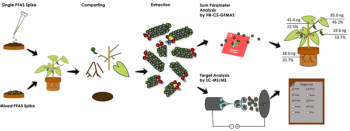
PFAS spiking experiments in bean plants (Phaseolus vulgaris)
Atomic Perspectives
This Atomic Perspectives column explains how high-resolution continuum source graphite furnace molecular absorption spectrometry (HR-CS-GFMAS) quantifies extractable organic fluorine (EOF) as a PFAS sum parameter, complementing LC-MS/MS target analysis, with applications to German river sediments, bean plants, and fluorinated polymer sealing materials.