The 2026 Lester W. Strock Award recipient discusses how single-particle ICP-MS can distinguish engineered and natural nanoparticles and track metalloid pollution downwind of industrial sites.
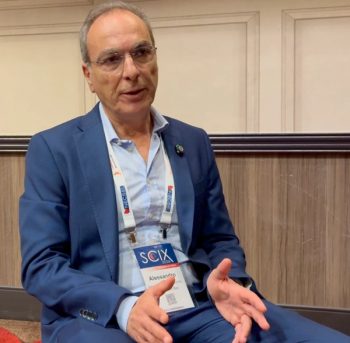
At SciX, Alessandro De Giacomo explains how a 35-member international jury chose three papers: one on correct ICCD use and two applications using LIBS and LA-ICP-MS. He also explains what the selections say about the field.
In an interview at SciX, which took place in Sparks, Nevada, Alessandro De Giacomo, a professor at the University of Bari Aldo Moro in Italy and a longtime editorial board member of Spectrochimica Acta Part B: Atomic Spectroscopy, described how this year’s slate of selected papers came together and what the choices suggest about the direction of laser-based spectroscopy.
According to De Giacomo, the selection was not left to a single reviewer or a small committee. It was carried out by the full editorial board and editorial team, a jury he put at 35 international members. That meant the papers reflect a collective judgment from an international panel rather than an individual editor’s preference.
Three papers emerged from this year’s process, and De Giacomo noted that they differ in character. The first is a technical paper focused on the use of intensified charge-coupled device (ICCD) detectors. Rather than reporting a new application, it addresses how to use the instrumentation correctly, a practical concern for laboratories that rely on gated ICCD cameras to capture time-resolved emission from laser-induced plasmas.
The other two selections are application papers, which De Giacomo called very interesting. One uses
Taken together, De Giacomo said, the papers point to a broader trend. In his view, laser ablation is becoming a very mature technology, one that is now ready to support very advanced applications, and this year’s selections illustrate exactly that progression. The pairing of an instrumentation-focused paper with two application-driven studies reflects a field that is refining its fundamentals while extending its reach.
(1) De Giacomo, A.; Workman, J., Jr.; Wetzel, W. Alessandro De Giacomo on LIBS, Plasma Physics, and Nanoparticle Size. Spectroscopy Online, 2026.
(2) De Giacomo, A.; Workman, J., Jr.; Wetzel, W. Beyond the Plasma: Alessandro De Giacomo on Laser–Matter Interaction and Nanoparticle Tagging. Spectroscopy Online, 2026.