News|Webcasts|August 13, 2024

New UV Spectrometer Enables Real-Time Water Monitoring

Author(s)Hamamatsu

Webinar Date/Time: Wed, Sep 18, 2024 9:00 AM EDT

Uncover the advancements in water quality management with our compact UV spectrometry technology. Thanks to real-time UV spectroscopy, wide wavelength coverage, compact design, and enhanced performance features, we can reshape the landscape of water quality monitoring.

Register Free: https://www.spectroscopyonline.com/spec_w/water-monitoring

Event Overview:

Uncover the advancements in water quality management with our compact UV spectrometry technology. Thanks to real-time UV spectroscopy, wide wavelength coverage, compact design, and enhanced performance features, we can reshape the landscape of water quality monitoring.
From tackling environmental concerns to ensuring safe drinking water, delve into the innovative solutions addressing global water challenges.


Key Learning Objectives:

  • Methods used for water quality monitoring
  • Benefits of optical methods for water quality monitoring
  • Applications for UV-VIS spectroscopy

Who Should Attend:

  • Product developers, optical engineers, R&D engineers, QA/QC engineers
  • Product managers, business developers
  • Academic researchers involved with spectral measurements
  • Professionals from life science, medical, pharmaceutical, and environmental sectors
  • Experts involved with UV spectroscopy

Speaker:

Gaetano Panagia
Technical Marketing Engineer
Hamamatsu Photonics Europe

Gaetano Panagia is a technical marketing engineer at Hamamatsu Photonics Europe. Panagia has been with the company since 2021 and specializes in the promotion and sales support of photonics components, including midinfrared detectors, light sources, and spectrometers. He actively promotes the adoption of Hamamatsu's products for environmental sensing and agricultural photonics applications. 
Prior to joining Hamamatsu, Panagia worked as an application engineer in the US, where he assisted customers in selecting machine vision components such as lenses, detectors, illumination, and software.
Panagia’s educational background includes a master’s degree in biomedical engineering from Italy’s Politecnico di Torino in 2016.

Register Free: https://www.spectroscopyonline.com/spec_w/water-monitoring

Related to this article

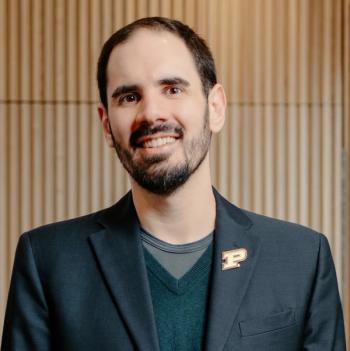
Brandon E. Boor is the Dr. Margery E. Hoffman Associate Professor in the Lyles School of Civil and Construction Engineering at Purdue University. | Photo Credit: © Brandon Boor.
In the second part of our interview with Brandon Boor of Purdue University, he discusses how his team controls experimental variables during cleaning experiments in order to obtain interpretable data.
Scientist With Portable Spectrometer in Natural Field Setting ©  By Tika -chronicles-stock.adobe.com
The bulky bench-top NIR spectrometer is quietly being dismantled and rebuilt as a wafer-scale photonic chip, a self-calibrating algorithm, and a sensor small enough to ride in a shirt pocket. What once demanded a grating, a moving mirror, and a climate-controlled lab now fits inside a handheld module, a bioreactor probe, or a drone payload, and it increasingly figures out what it is looking at on its own.
Sizing Up the Nanoscale: Measuring Nanocluster Aerosol in Indoor Air
In the first part of a multi-part Q&A, Brandon Boor, the Dr. Margery E. Hoffman Associate Professor in the Lyles School of Civil and Construction Engineering at Purdue University, describes the instrumentation and methodology behind measuring nanoparticle size distributions at the nanocluster scale (1–3 nm) and outlines the technical challenges of acquiring reliable, real-time data at these dimensions.
Human body wireframe on glowing platform undergoing futuristic body scan. © sergray(noAIelemens) -chronicles-stock.adobe.com
Jurgen Popp, Thomas Mayerhofer, and colleagues at Leibniz IPHT and Friedrich Schiller University Jena introduce the Personalized Optical Digital Twin (PODT), a Photonics21 contribution to Europe's Virtual Human Twin ecosystem that connects molecular photonics—Raman blood analysis, coherent Raman tissue imaging, and multimodal endomicroscopy—with longitudinal physiology and clinical data. Drawing on the published multicenter INTELLIGENCE trials, the authors argue that technical feasibility and clinical utility must be evaluated separately as the field moves toward Europe's FP10 research agenda.