SPEC PerkinElmer 11.10
|Articles|August 14, 2018

New York Society for Applied Spectroscopy Announces Speakers for Fall 2018 Meetings

The New York and New Jersey section of the Society for Applied Spectroscopy (NYSAS) has announced the speakers and schedule for its fall 2018 meetings.

The New York and New Jersey section of the Society for Applied Spectroscopy (NYSAS) has announced the speakers and schedule for its fall 2018 meetings.

September 13, 2018: John Wasylyk of Bristol-Myers Squibb, on the Development of 'Fit for Purpose' Near Infrared Spectroscopic Methods for Lyophilized Biopharmaceuticals to be held at Horiba Scientific, 20 Knightsbridge Road, Piscataway, New Jersey, from 5:15 to 8:00 pm.

October 2018: Christine Sayhoun, of Marc Pierce’s group at Rutgers University, on “A Comparison of Structural and Functional Optical Coherence Tomography Systems for Assessment of Hard Dental Tissues.”

November 2018: Eastern Analytical Symposium (EAS) Gold Medal Award Program honoring Professor Igor Lednev of the University of Albany, sponsored by the New York and New Jersey SAS and EAS (held in conjunction with EAS).

December 5, 2018:Curtis Marcott of Light Light Soluctions on  “Perspectives on the Future of IR Spectroscopy: IR Beyond the Diffraction Limit at Submicron and Nanoscale Spatial Resolutions via Photothermal Techniques.” Marcott’s talk is part of a special speaker tour organized by the national SAS organization.

Due to the required lead times for publication, the New York SAS is providing this announcement before all of the details of the meetings have been arranged. The meeting details will be posted on the NYSAS website: www.nysas.org as soon as they become available. Please consult the website regularly for details, possible changes, and information about future meetings. Those planning to attend a meeting are requested to email the NYSAS secretary debperu@outlook.com beforehand so arrangements can be made for the expected number of people. Attendee names will be added to the e-mail list for future meeting announcements unless a request to opt out is provided.


Related to this article

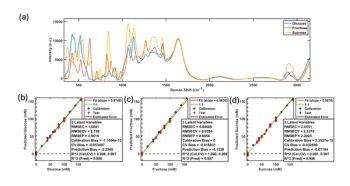
Monitoring Sugar Consumption and Ethanol Production During Yeast Fermentation Using a Raman Plate Reader and Multivariate Analysis
This column shows that a Raman plate reader paired with partial least squares regression can simultaneously quantify glucose, fructose, sucrose, and ethanol in yeast fermentation samples, using turbidity-matched calibration standards to correct for yeast-induced turbidity, and offers a rapid, label-free, high-throughput method for tracking sugar consumption and ethanol production in strain screening, media optimization, and process development.
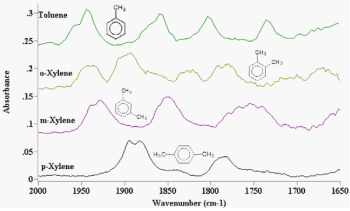
Highly Substituted Benzene Rings—The Rest of the Story II: Spectra
This column, the second installment on highly substituted benzene rings, shows that tri- and tetra-substituted substitution patterns can be distinguished by whether the ring bending peak is present and by the position of the in-phase aryl C-H wagging peak, which shifts according to how many adjacent hydrogens the ring carries.
Healthcare administrator reviewing an insurance policy schedule with a stethoscope on a clipboard, health insurance coverage, medical underwriting, prior authorization, and patient claims processing. | Image Credit: Joi_studio - stock.adobe.com
In a SciX interview, Marc Porter covered a lot of ground, from a student-driven pivot into immunoassays to a baseball analogy for Stokes and anti-Stokes scattering, and shares the open questions he is still chasing.
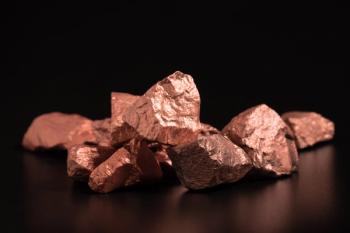
Ingots of pure copper or pink gold on a black background. | Image Credit: Phawat - stock.adobe.com
At SciX, Kevin Wilkinson of the Universite de Montreal explains how faster data acquisition and new software have cut analysis time and how a particle’s chemical composition can link arsenic-bearing emissions back to a copper refinery’s processes.
Spectral Frontiers: Seeing the Unseeable Microspectroscopy
Microspectroscopy, the marriage of spectroscopic chemical identification with microscopic spatial resolution, has advanced from Perkin-Elmer's first commercial infrared microspectrometer in 1953 to today's nanoscale AFM-IR probes, synchrotron-brightness infrared beamlines, and compact hyperspectral tissue imaging devices being developed for AI-assisted cancer detection.