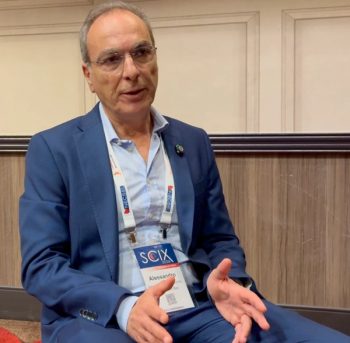
The 2026 Lester W. Strock Award recipient discusses how single-particle ICP-MS can distinguish engineered and natural nanoparticles and track metalloid pollution downwind of industrial sites.
Atomic spectroscopy has quietly moved past splitting light and counting ions toward instruments that track a single nanoparticle, fuse a laser pulse with an isotope-ratio mass spectrometer, and correct their own interferences with artificial intelligence in real time. The result is a new class of ICP-MS, LIBS, and X-ray fluorescence (XRF) platforms that are turning what used to be a benchtop-only science into field-ready, self-optimizing analytical intelligence.
Atomic spectroscopy instrumentation is undergoing its most consequential redesign in a generation. Time-of-flight mass analyzers now count individual nanoparticles and resolve their isotopic content one at a time, multi-collector inductively coupled plasma-mass spectrometry (ICP-MS) systems have shed their rigid, single-purpose architectures for reconfigurable high-resolution designs, and laser-induced breakdown spectroscopy (LIBS) has jumped from geology outposts and scrap yards into hospital laboratories and pharmaceutical quality-control lines. Underneath nearly every one of these advances sits the same quiet enabler: artificial intelligence and chemometric software that corrects spectral interferences, flags anomalies, and predicts concentrations faster than a human operator ever could. This article reviews the instrumentation developments most likely to matter to working spectroscopists, drawing on the past five years of coverage in Spectroscopy and the peer-reviewed literature, and considers where the technology is headed next.
For most of its history, atomic spectroscopy instrumentation improved incrementally: a slightly better detector here, a slightly hotter plasma there. That pattern has broken. Reviewing product introductions and peer-reviewed advances from 2021 through 2026 reveals a field being reshaped by three converging forces — single-particle and single-cell resolution, technique fusion at the point of the laser pulse, and artificial intelligence embedded directly into instrument control software. None of these ideas is entirely new on its own, but their convergence is producing instruments that would have been unrecognizable to an atomic spectroscopist a decade ago. What follows is a tour of the developments that working analysts, journal editors, and instrument buyers have flagged as the most consequential.
Conventional ICP-MS homogenizes a sample before measuring it, which means a technique built to detect parts per trillion still cannot tell an analyst whether an element is dissolved, bound to a protein, or locked inside a nanoparticle. Single-particle inductively coupled plasma time-of-flight mass spectrometry (SP-ICP-TOF-MS) solves that problem by measuring transient ion clouds from individual particles as they pass through the plasma, one at a time.1 Researchers at Oak Ridge National Laboratory used the approach to determine, particle by particle, how efficiently enzyme-functionalized magnetic microparticles captured platinum from a mixed matrix, distinguishing bound metal from free background contamination in a way that bulk digestion could never achieve.1 Pairing the measurement with an automated single-cell introduction system allowed the team to run unattended for more than eight hours, a throughput jump that matters as much to a working laboratory as the sensitivity gain itself.2 The same group has since pushed the technique toward automated, high-throughput nanoparticle sizing and isotopic analysis, cutting analysis time while improving reproducibility across particle populations.2
Multi-collector ICP-MS has long delivered the field's most precise isotope ratios, but at the cost of rigidity: instruments were typically purpose-built for a narrow set of isotope systems. New multi-collector platforms introduced over the past year abandon that trade-off, offering reconfigurable detector arrays that let a single instrument resolve isotopes of interest from their spectral interferences across a much wider range of applications, from geochronology to nuclear forensics.3 That flexibility matters because the alternative, historically, was buying a second (or third) dedicated instrument.
Perhaps the most elegant instrumentation trick of the past five years is a literal fusion: firing a single laser pulse at a particle and extracting two independent data streams from it. LIBS captures the pulse's optical emission for rapid elemental fingerprinting, while the same ablation event feeds a multi-collector ICP-MS for isotope-ratio determination.4 Applied to uranium-bearing particles relevant to nuclear nonproliferation, the combined LIBS/laser ablation-multicollector-ICP-MS workflow yielded simultaneous fluorine and uranium isotopic information from particles that would otherwise have required two separate sampling events, sacrificing precious sample material along the way.4 It is a preview of where technique fusion is headed: fewer samples destroyed, fewer instruments needed, more information extracted per laser shot.
Sample matrix has always been the villain of quantitative atomic spectroscopy — high dissolved-solid loads clog cones, quench plasmas, and swamp trace signals. Newer ICP-MS platforms address this directly with ultra-high matrix introduction systems that use controlled aerosol dilution to let instruments analyze samples containing up to roughly 25% total dissolved solids without manual dilution.5 Layered on top of the hardware, collision/reaction-cell chemistry now pairs with automated tuning and artificial intelligence-assisted predictive modeling to strip out polyatomic interferences and flag anomalous readings before they reach a report.5 Vendors across the ICP-optical emission spectroscopy (ICP-OES) and ICP-MS space have converged on the same playbook: faster plasma stabilization, cloud-connected data management, and software that increasingly makes the interference-correction decisions a senior chemist used to make by hand.5
LIBS built its commercial reputation on scrap-metal sorting and geochemical fieldwork, where its ability to fire, read, and report in seconds made it ideal for rugged, handheld instruments. That reputation is now expanding into an unexpected direction: biomedicine. A 2026 review in Applied Spectroscopy Reviews surveyed LIBS applications across biological fluids, tissues, and pharmaceuticals, concluding that the technique's label-free, minimally destructive, simultaneous multi-element readout could support near-real-time screening of blood and urine for electrolyte and trace-metal abnormalities, rapid tissue characterization, and pharmaceutical quality control tasks such as formulation-uniformity testing.6 The same review is candid about what stands in the way: matrix effects in biological samples remain severe, and calibration, standardization, and large-cohort validation studies are still needed before LIBS moves from promising screening tool to accepted clinical or regulatory method.6 That candor is itself notable, since it signals a technique's maturation from novelty demonstrations to serious translational research.
Handheld and benchtop XRF and LIBS analyzers introduced over the past year illustrate how far field-portable atomic spectroscopy has come. New energy-dispersive XRF systems now pack graphene-window silicon drift detectors and autosamplers capable of processing dozens of samples unattended, while portable LIBS platforms report single-digit part-per-million detection limits across diverse matrices with minimal sample preparation.5 Combined with embedded AI-assisted spectral interpretation, these instruments are closing the sensitivity gap that once separated field tools from laboratory-grade analyzers, without sacrificing the ruggedness and speed that make them useful outside a controlled lab environment.5
Taken together, these developments describe an instrumentation landscape moving in the same direction from several different starting points: toward finer resolution (single particles, single isotopes), toward fused measurements that extract more information from less sample, and toward software that takes on cognitive tasks — interference correction, anomaly detection, calibration — that used to require years of operator experience. Multi-collector ICP-MS has become more versatile rather than more specialized.3 Single-particle time-of-flight instruments have made the invisible distinction between bound and free metal visible.1,2 LIBS has proven it can leave the geology lab for the clinic, even as real barriers to full clinical adoption remain.6 None of these advances stands alone; each depends on the steady, less visible progress in detectors, lasers, and chemometric software described throughout the current literature.3
The near-term trajectory is reasonably predictable from the developments already in commercial pipelines: expect continued convergence between LIBS, ICP-MS, and imaging modalities at the single-particle and single-cell level, wider adoption of AI-assisted interference correction as a standard rather than a premium feature, and further miniaturization that pushes multi-element quantitation into point-of-care and point-of-use settings.5,6 The atomic spectrometry community's own annual literature reviews continue to track expanding activity in environmental, clinical, and nuclear forensic applications, suggesting the instrumentation advances covered here are being matched by an equally rapid expansion in where and how they are applied.3 The harder, less predictable question is whether validation science, particularly for biomedical LIBS and other emerging clinical applications, can keep pace with the instrumentation's evident capability. If it does, the next five years of atomic spectroscopy instrumentation may be defined less by what these machines can measure and more by where they are now trusted to measure it.
(1) Bradley, V. C.; Manard, B. T.; Hendriks, L.; Dunlap, D. R.; Bible, A. N.; Sedova, A.; et al. Quantifying Platinum Binding on Protein-Functionalized Magnetic Microparticles Using Single Particle-ICP-TOF-MS. Anal. Methods 2024, 16, 3192–3201. DOI:
(2) Manard, B. T.; Bradley, V. C.; Quarles, C. D.; Hendriks, L.; Dunlap, D. R.; Hexel, C. R.; Sullivan, P.; Andrews, H. B. Towards Automated and High-Throughput Quantitative Sizing and Isotopic Analysis of Nanoparticles via Single Particle-ICP-TOF-MS. Nanomaterials 2023, 13 (8), 1322. DOI:
(3) Miseo, E. V. 2025 Review of Spectroscopic Instrumentation. Spectroscopy 2025, 40 (4), 26–31. DOI:
(4) Manard, B. T.; Quarles, C. D., Jr.; Bradley, V. C.; Spano, T. L.; Zirakparvar, N. A.; Ticknor, B. W.; Dunlap, D. R.; Cable-Dunlap, P.; Hexel, C. R.; Andrews, H. B. Uranium Single Particle Analysis for Simultaneous Fluorine and Uranium Isotopic Determinations via Laser-Induced Breakdown Spectroscopy/Laser Ablation-Multicollector-Inductively Coupled Plasma-Mass Spectrometry. J. Am. Chem. Soc. 2024, 146, 14856–14863. DOI:
(5) Workman, J., Jr. New Product Advances in Vibrational and Atomic Spectroscopy (2025–2026). Spectroscopy 2026, 41 (2), 16–21. DOI:
(6) Chen, W.; Li, F.; Sattar, H.; Hou, Z.; Guo, L. Laser-Induced Breakdown Spectroscopy in Biomedicine: Principles, Data Analytics, and Applications in Biofluids, Tissues, and Pharmaceuticals. Appl. Spectrosc. Rev. 2026, 1–47. DOI: