A candid plenary on the incentives shaping academic science was followed by an afternoon of talks spanning flowing SERS detection, historical textiles, maple syrup, pathogen immunoassays, and electrochemical Raman microscopy.
The recipient of the ACS Award in Spectrochemical Analysis discusses how surface-enhanced Raman scattering became a practical diagnostic readout and how close it is to clinical use.
Marc Porter, a Distinguished Professor Emeritus in Chemistry and Chemical Engineering at the University of Utah, is the recipient of the ACS Division of Analytical Chemistry Award in Spectrochemical Analysis.1 The award recognizes outstanding contributions to the field and has previously gone to researchers including Ji-Xin Cheng and Weihong Tan.1
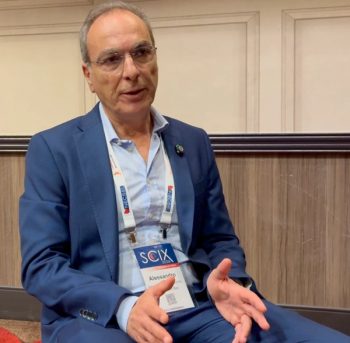
As part of our coverage of the 2026 SciX Conference in Sparks, Nevada, Spectroscopy sat down with Porter to talk about his research. In this clip, Porter reacts to winning the ACS Division of Analytical Chemistry Award in Spectrochemical Analysis and discusses how surface-enhanced Raman spectroscopy (SERS)-based immunoassays and Extrinsic Raman Labels turned a spectroscopic signal into a practical diagnostic readout.
Porter's research examines chemical, physical, and biological phenomena at liquid-solid interfaces, with an emphasis on Raman spectroscopy, surface-enhanced Raman scattering (SERS)-based immunoassays, and plasmonic surface design.2 He has published more than 250 peer-reviewed papers and delivered more than 430 invited lectures.2 His honors include the 2003 R&D 100 Award for Extrinsic Raman Labels, the 2011 ANACHEM Award, and the 2025 Charles Mann Award for Applied Raman Spectroscopy.2
In our conversation, Porter compared SERS with more conventional readout methods, such as fluorescence and colorimetric assays, in terms of sensitivity and practicality for real diagnostic use in heterogeneous immunoassays for infectious disease and cancer detection. He also addressed how close the approach is to clinical deployment.
Drawing on his experience presenting to chemists, engineers, and clinicians over hundreds of invited lectures, Porter identified the most common misconception about Raman-based technology that he has had to correct across audiences.
The conversation also shifted to the title of his SciX talk, which connects the physical basis of Raman scattering to the mechanics of hitting a 95+ mph major league fastball. Porter explained where that comparison came from and what it captures about Raman scattering that a more conventional physics analogy would not.
Finally, Porter, who remains active in publishing and lecturing as an emeritus professor, also shared the unfinished question from earlier in his career that he is still working to answer.
We are looking forward to sharing with you the rest of our conversation with Porter soon. You can stay up to date on all our coverage of